Quarta-feira, Dezembro 28, 2005

Haiti, Brasil, Jordan

See just this Post & Comments / 0 Comments so far / Post a Comment /   Home
Next, Back, Thread Ahead: Michaëlle Jean and Redemption, Thread Back: None.

Sunday, March 12, 2006

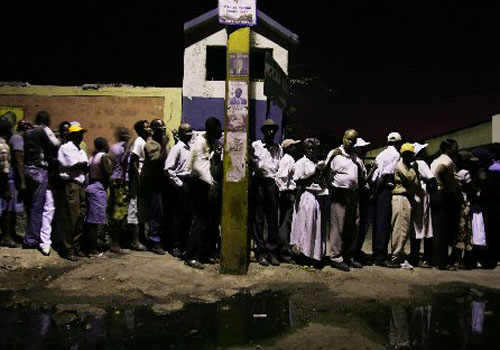
PORT-AU-PRINCE, Haiti (Joseph Guyler Delva/Reuters) - Haiti's electoral authorities on Saturday brought forward slightly the date for runoff elections to pick senators and legislators. Originally due to take place on March 19 and then rescheduled for April 23, the second-round vote will now take place on April 21, a Friday, ostensibly to allow officials the weekend to prepare for classes on Monday the schools that will be used as voting centers. "We finally decided to organize the second round on April 21, which is a Friday, for practical reasons," Max Mathurin, president of the Provisional Electoral Council, told Reuters.

None of the contenders in the races held alongside the presidential election on February 7 for 30 Senate seats and 99 seats in the lower house appear to have won the majority -- 50 percent plus one vote -- needed for a first-round victory.

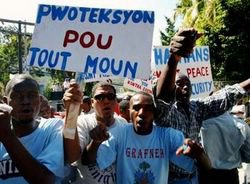
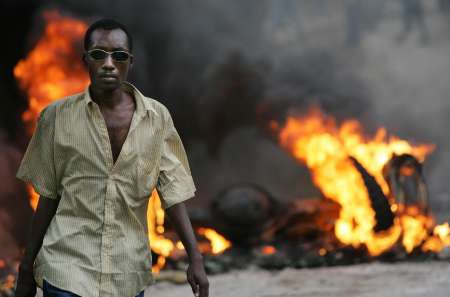
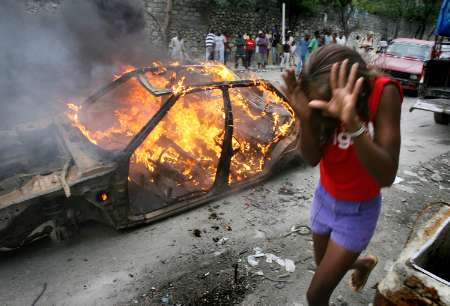
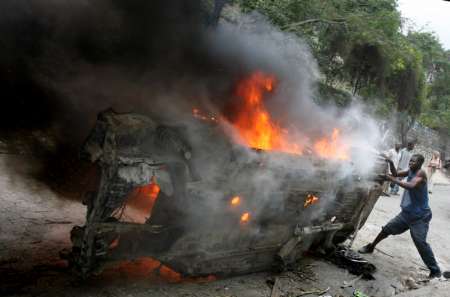
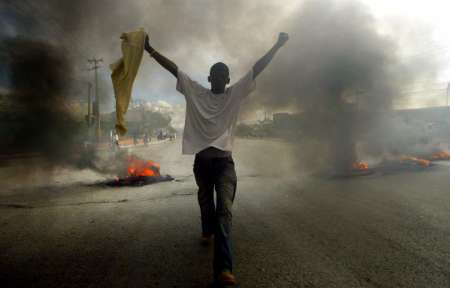
Meanwhile there are demonstrations in Port-au-Prince around release of political prisoners.
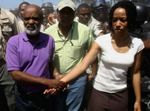

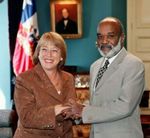
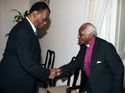
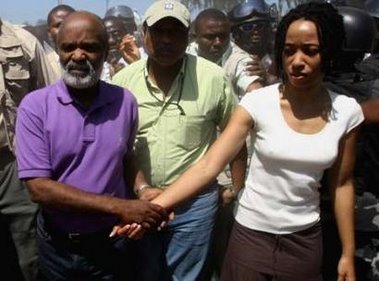
Walking with his daughter in the town of Leogan, Haiti March 8; meeting U.S. Secretary of State Condoleezza Rice in Santiago March 11; meeting Chile's President Michelle Bachelet at La Moneda presidential palace in Santiago March 12.

Saturday, March 11, 2006

Spain will pull out of the United Nations peacekeeping mission despite a request that its forces stay until Haiti finishes its stalled electoral process, David Wimhurst, a spokesman for the mission, said, calling the move "an internal political decision" by the Spanish government. He said Spain's 200 troops in northeast Haiti would be replaced by Uruguayan soldiers already in the country. Spain said last year that it would reconsider its participation in the 9,000-member peacekeeping force unless international donors complied with pledges to finance reconstruction. Haiti so far has received only slightly more than half of the $1 billion pledged.

Friday, March 3, 2006

I usually stay right away from news of celebrities. I will make an exception for Wyclef Jean - any relation to our Michaëlle I wonder?

Haiti is my native country, one I know as the first Black nation to gain independence in 1804 ... Wyclef Jean.

Yéle Haiti

Thursday, February 23, 2006
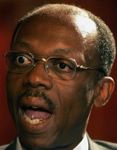
Ousted Haitian leader Jean-Bertrand Aristide, speaks during an interview in Pretoria, South Africa, Wednesday, Feb. 22, 2006. Aristide is ready to return to Haiti after what he calls an unconstitutional exile, but said when was up to his country's president-elect and other leaders. He has been a 'guest' of the South African government since he was ousted in February 2004. On Wednesday he sent congratulations to the Haitian people and to President elect Rene Preval on the Feb. 7 election. (AP Photo/Themba Hadebe)

If there was any doubt about Aristide this has to clear it up - the guy is a loose cannon! Is there any question that his return to Haiti at this time would be a disaster?
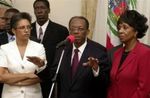
In this Saturday Feb 21, 2004 file picture, then-Haitian President Jean-Bertrand Aristide, his wife Mildred, left and U.S. Rep. Maxine Waters D-Calif., give a news conference in the National Palace of Government in Port-au-Prince, Haiti. He left the country later that month. (AP Photo/Pablo Aneli)

Friday, February 17, 2006

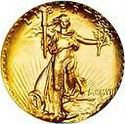
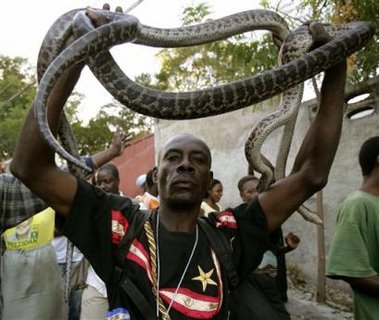
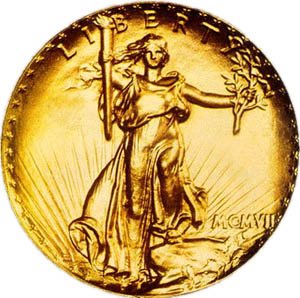
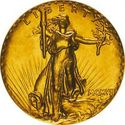
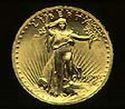
Some carry snakes, more carry branches, on the Saint-Gaudens double eagle (20$ gold coin) Liberty carries a torch in her right hand and a branch in her left.


Thursday, February 16, 2006

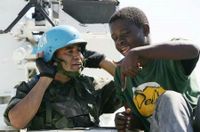
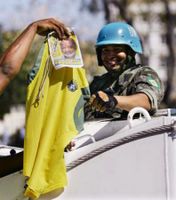
This is where I started this post, seeing how the Brasilian peacekeepers ARE with the people of Haiti.
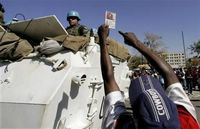
Preval declared the winner by removing some of the blank votes. He will take office on March 29.

Wednesday, February 15, 2006

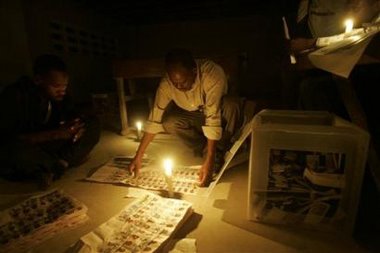
AP: Election Material Found in Haitian Dump

Votes apparently dumped (at the dump? that's crude and stupid) and Preval crying foul. Looks like a plant to me. Were there not Canadian observers watching (and paying for?) this whole process? Ok, the lefties are claiming Canadian complicity in some kind of conspiracy against Aristide, cock in hand with the US - but I find it unbelievable. This votes-in-the-dump thing looks like it is staged. Whoever did it may simply be agitating for continued ructions? Preval setting it up because he really did not win legitimately? The upper crust setting Preval up for a fall? Where is our Canadian Governor General in all this?

Monday, February 13, 2006



Yahoo: Violence Erupts Over Haiti Vote Count



NYT: Tension Increases in Haiti as Front-Runner's Lead Drops


Friday, February 10, 2006
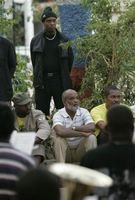

Looking like Preval by a landslide. Final results will not be available for a few days.

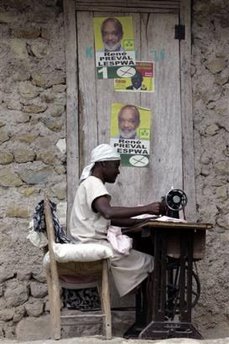
Rene Garcia Preval: (this is some of his pre-election bumph)

René Préval, born January 17, 1943, was the President of Haiti from February 7, 1996 to February 7, 2001. René Préval was also prime minister from February 13 to October 11, 1991, but was replaced following the military coup of that year.

René Préval was an ally of Jean-Bertrand Aristide and a leader of the Lavalas Family party. René Garcia Préval was inaugurated President of the Republic of Haiti on February 7, 1996, the second democratically elected head of state in the country's 200-year history.

Prior to that in 1995, he directed the Economic and Social Assistance Fund. He served as Prime Minister in the administration of President Jean-Bertrand Aristide from February 1991 until the military coup d'état of September 29th forced him to seek refuge at the French and Mexican Embassies in Port-au-Prince before joining the exiled Constitutional Government in Washington, D.C. from 1992-94.

Mr. Préval retained the Premier's portfolio as well as those of Interior and Defense until August 1993 when he was retained by President Aristide as chief adviser.

A reserved and pleasant man, Mr. Préval has taken a pragmatic approach to problem solving and is well known for what is known in Haiti as ce bon sens paysan.

He was born on January 17, 1943 in Port-au-Prince, one of four children. He holds a degree in agronomy from the College of Gembloux in Belgium and has a background in both engineering and geothermics.

As a young man he was forced to leave Haiti with his family in 1963 after they were targeted by dictator François "Papa Doc" Duvalier. Returning to the country in 1975 after also spending five years in Brooklyn, New York, he obtained a position with the National Institute for Mineral Resources. Following the fall of Jean-Claude "Baby Doc" Duvalier in February 1986, Mr. Préval became active in many popular organizations and voluntary agencies.

These included Lafanmi Selavi (The Family is Life), an orphanage and educational facility launched by Father Jean-Bertrand Aristide, the Fred Coriolan Committee, and the Komite Pa Bliye (Always Remember Committee), which sought justice for the innumerable victims of the Duvalier family dictatorship. He also played a primary role in the Initiative Group of Civil Society for the Respect of the Constitution known as Honneur - Réspect (Honor - Respect) which paved the way for a provisional civilian government to hold the historic, democratic elections of December 1990.

Mr. Préval played no small role in the landslide election of Jean-Bertrand Aristide. Together with businessman Antoine Izmery, they were the architects of Father Aristide's stunning electoral victory. Often referred to as Titid's "twin," Mr. Préval has sought to continue the work started by his predecessor in widening the aperture for popular, grassroots political participation and the reform and modernization of State institutions.

Mr. Préval, the father of two teenage daughters, one who studies in Paris and another who studies in Canada, was married to Ms. Guerda (Geri) Benoît on July 12, 1997.

Tuesday, February 7, 2006


Thursday, February 2, 2006

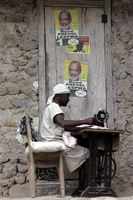
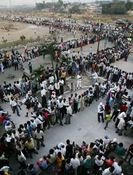
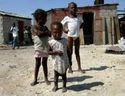
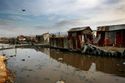
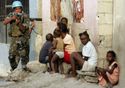
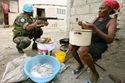
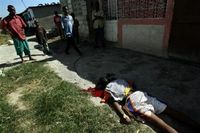
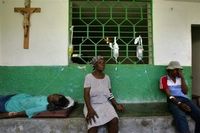
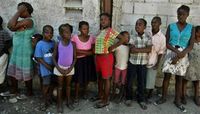
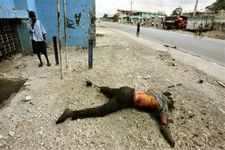
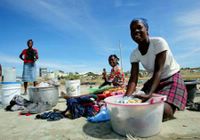
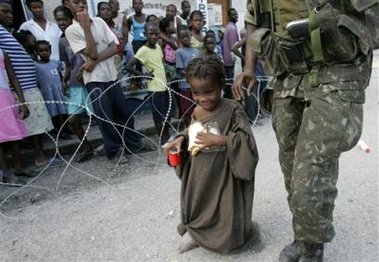
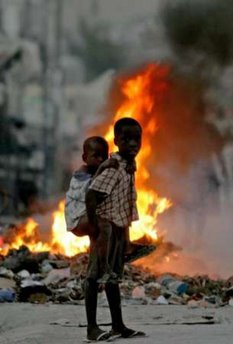
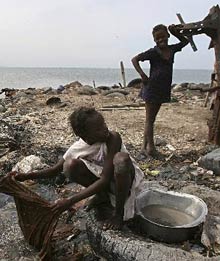
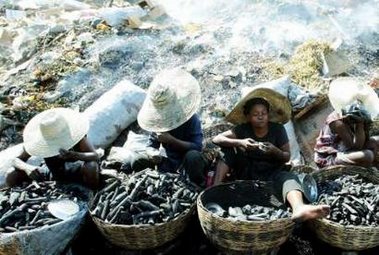
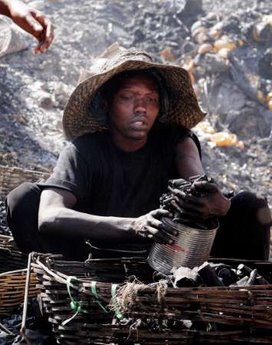
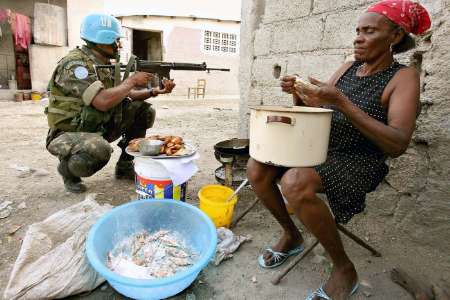
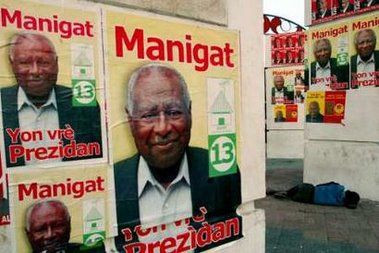
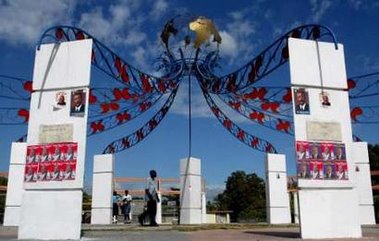
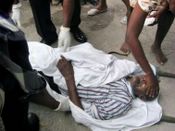
Charcoal sellers, part of the tragedy since deforestation for charcoal-making leaves the hills un-ready to accept moisture when it rains, and contributes to floods. No doubt the living they make with charcoal is tiny. 54 candidates in the list I found, but ony 33 on the ballot pictured - even 33 is far too many it seems to me. How does the election work I wonder with 33 candidates, stages? run-offs? UN troops shooting it out on the streets of Dodge - the women and kids do not seem too impressed, maybe the shots were staged. Garbage fires in the streets and sewage canals behind the houses. A little girl looking friendly enough with the military vehicles, makes me wonder what she might be thinking. Finally, a woman praying in a church.

They will suspend electioneering prior to the election, next Tuesday the 7th.



Paul English, Haiti travels, lots of good photos.

Tuesday, January 31, 2006

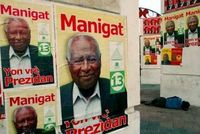
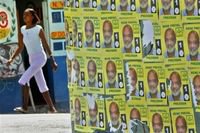
Candidates, 55 of 'em by my count - who can make sense of an election with 55 candidates?:
Armand, Pierre C.
Baker, Charles Henry
Bazile, Francoeur
Bazin, Marc Louis
Belizaire, Dejean
Belot, Jacques Ronald
Boisron, Jn-Michel
Bonivert, Claude
Borgella, Joel
Buteau, Jean Henold
Calixte, Guerrier
Cherestal, Jean-Marie
Delpe, Turneb
Denis, Paul
Deronceray, Hubert
Destin, Marc Antoine
Duplan, Joseph Rigaud
Dupuy, Elie
Fleurinor, Luc
Francisque, Edouard
Gabriel, Nicolas Pierre Philippe
Georges, Reynold
Gilles, Louis Gerald
Gilles, Serge
Gourgue, Gerard
Guillaume, Jean Gilbert
Jacques, Nicolas Jose
Jeune, Jean Chavannes
Joseph, Dominique
Joseph, Lafortune
Julien, Rene
Justima, Emmanuel
Liberus, Raoul
Manigat, Leslie Francois
Martin, Denis Arioste
Mesadieu, Luc
Mourra, Samir Georges
Nicolas, Evans
Paul, Alexandre
Paul, Arcelin
Paul, Evans
Perpignan, Frantz
Phillippe, Guy
Preval, Rene Garcia
Principal, Arnold
Rebu, Himmler
Romain, Charles Poisset
Romain, Franck Francois
Roy, Judie Joe C. Marie
Saint Louis, Yves Marais
Saint Louis, Yves Maret
Saint-Natus, Clotaire
Simeus, Dumarsais
Sylvain, Jean Jacques
Toussaint, Dany
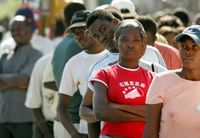
The girls in the sweatshop (making sweatshirts by the seashore) are paid 3-4 dollars per day, that's probably US$. This is apparently twice the minimum wage. When I was in Brasil I heard that 1 US$ per day is the real breakpoint - below that you are not surviving at all. At that time Brasil's minimum wage was 180 R$ per month which at the time worked out to about 2 US$.

And the Haitian entrepreneurs are complaining that all the violence is making it hard to stay in business. No doubt it is.

Saturday, January 28, 2006
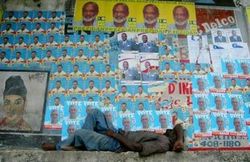
ABC: Four Hostages Released Unharmed in Haiti



Friday, January 27, 2006

BBC: Aristide's long shadow over Haiti

Thursday, January 26, 2006

Gwynne Dyer: Haiti - No Easy Way Out

Tuesday, January 24, 2006
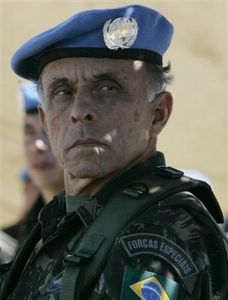
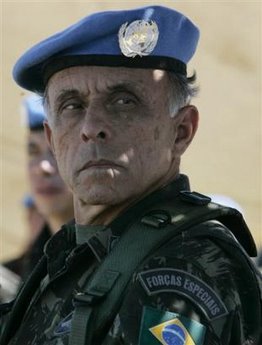
Jose Elito Carvalho de Siqueira

NYT: Fear and Death Ensnare U.N.'s Soldiers in Haiti


Wednesday, January 18, 2006

BBC: New peacekeeping head for Haiti
Jose Elito Carvalho de Siqueira
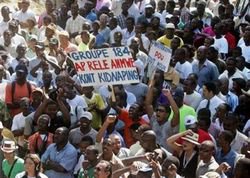


Regarding funding for the Group of 184
Yahoo: Two Jordanian U.N. Peacekeepers Killed in Haiti

Friday, January 13, 2006
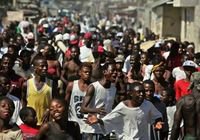
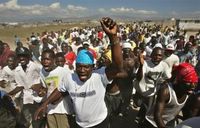
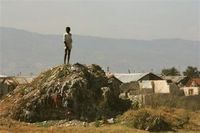
Street demonstrations in Cite Soleil and some Haitian realities, saving the best for last.

Monday, January 9, 2006
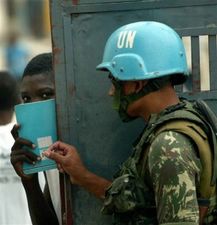

Reuters: Haiti sets new election for February 7

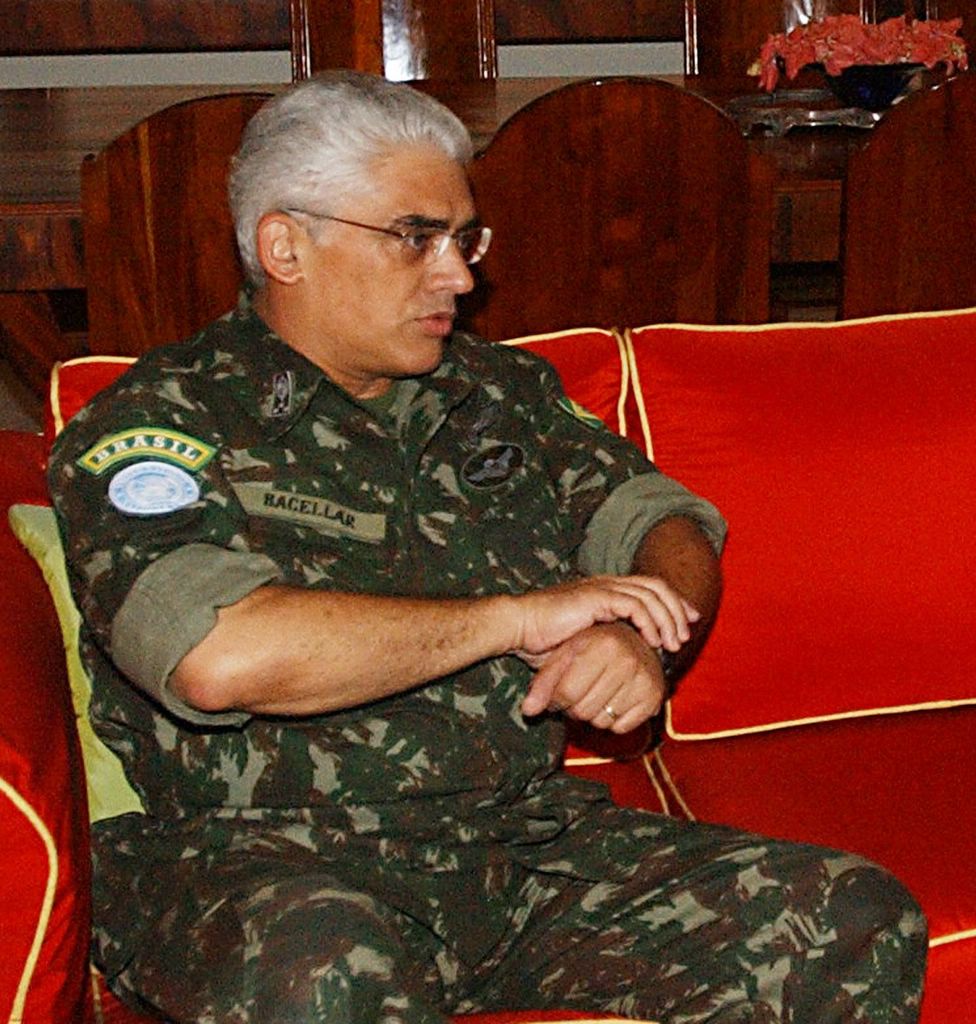
Brasília - Presidente Lula, d. Marisa, o vice-presidente e ministro da Defesa, José Alencar e esposa, e representantes das Forças Armadas, durante cerimônia fúnebre em homenagem ao general Urano Bacellar, morto no Haiti no dia 7 de janeiro. (Foto Domingos Tadeu/PR)

Sunday, January 8, 2006
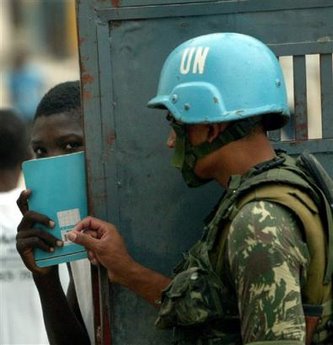
A Haitian informer stands with a U.N. peacekeeper from Brazil near the volatile neighborhood of Citi-Soleil in Port-au-Prince, Haiti January 8, 2006. U.N. mission head Juan Gabriel Valdes announced on Friday that U.N. troops would occupy the Cite Soleil slum, the capital's most dangerous ghetto, and warned that civilians could be harmed. Reuters/Eduardo Munoz

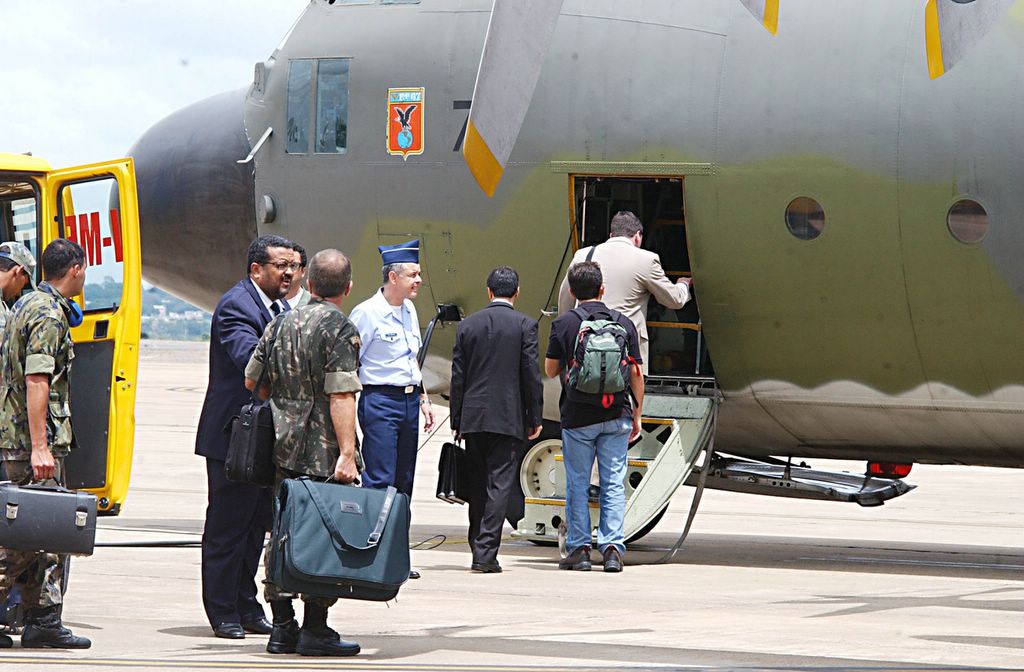
Brasil has sent a team to investigate: Brasília - Representantes do governo federal (delegado e peritos da Polícia Federal, um médico do Instituto Médico Legal do Distrito Federal, um representante da Agência Brasileira de Inteligência - Abin, um general e um coronel do Exército Brasileiro e um promotor do Ministério Público Militar), embarcam no avião da Força Aérea Brasileira (FAB) para o Haiti. O grupo vai acompanhar as investigações da morte do general brasileiro Urano Teixeira da Matta Bacellar, chefe militar da Missão das Nações Unidas para a Estabilização no Haiti (Minustah). (Foto Lindomar Cruz/ABr)

Saturday, January 7, 2006
Brazilian head of U.N. Haiti mission, Urano Teixeira da Mata Bacellar, found dead in capital after 'firearm accident'

BrGov: Ação da América Latina leva esperança ao devastado Haiti
Defesanet: Haiti - um grande desafio

Defesanet: Entrevista - General-de-divisão Urano Teixeira Bacellar

I am reminded of Roméo Dallaire, who very nearly cracked when he was on the front-line in Rwanda and Uganda. And here is a Brasilian, possibly under similar pressures, who has aparently killed himself.

MINUSTAH Press Statement
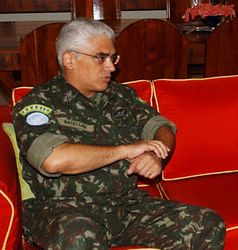
MINUSTAH, it turns out, is an acronym for Mission des Nations Unies pour la Stabilisation en Haïti aka the United Nations Stabilization Mission In Haiti. The 'official' language of this organization is apparently French. I would have thought it would be English, or, now that I think on it for a minute, Português even since the leadership on the ground has been mostly Brasilian. An oblique look at what is mostly (just, really, only,) a bureaucracy, and very probably a disfunctional one. Will anyone ever know what drove Bacellar over the edge? I noticed that he was wearing a wedding band in one of the pictures I saw. Maybe his wife knows.


Miami Herald: Losing patience, OAS, U.N. prod Haiti on election

Thursday, January 5, 2006

Haiti: Elections delayed again

Port-ao-Prince, Haiti, Jan 5 (UPI) - National Haitian elections -- scheduled for Jan. 8 -- have been postponed for the fourth time, said electoral officials. Elections could be rescheduled for early February following the fourth delay in the voting, Haitian radio reported Thursday. The elections were originally set for November but had to be postponed three other times due to lack of preparation and setbacks in voter registrations. Officials also said there were currently not enough polling centers. Haiti is struggling to hold its first election since the departure of former President Jean-Bertrand Aristide, who left the country in February 2004 amid an armed uprising by rebel groups calling for his ouster.

Tuesday, January 3, 2006

CCR: Timeline - The 2004 removal of Jean-Bertrand Aristide

Gwynne Dyer, 19 February 2004: Why Is Haiti Cursed?

Not quite sure what this is? Yves A. Isidor

NCR - National Catholic Reporter, Claire Schaeffer-Duffy: Rights abuses overshadow elections Haiti's government imprisons opposition; voters to go to polls Jan. 8

Wednesday, December 28, 2005

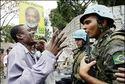
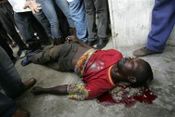
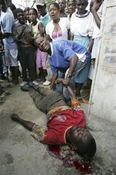
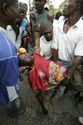
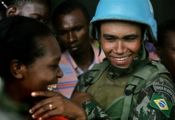
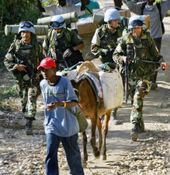
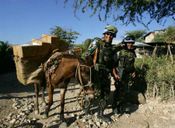
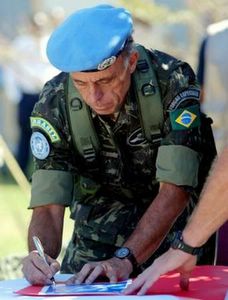
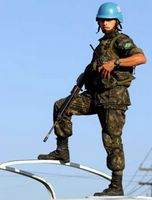
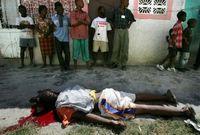
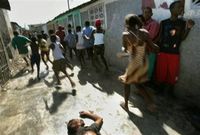
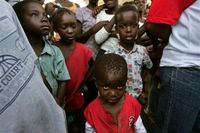
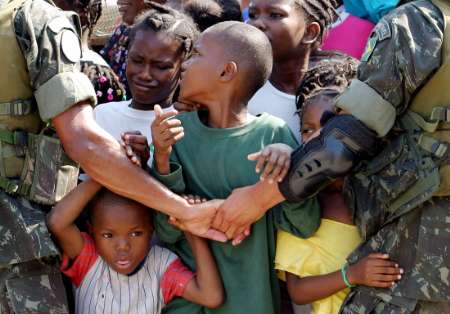
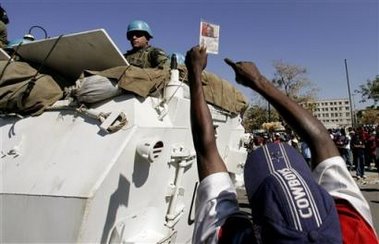
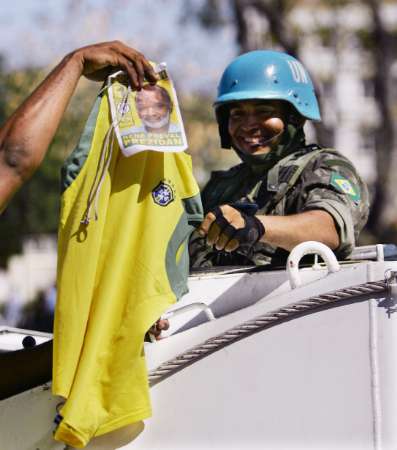
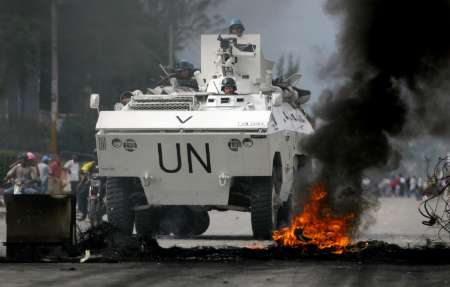
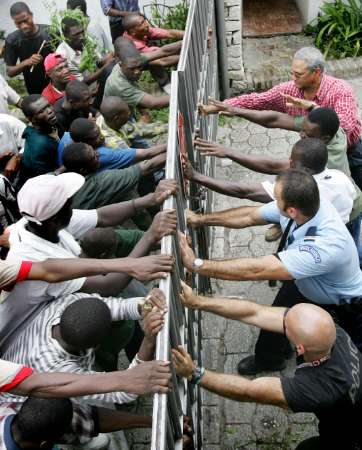
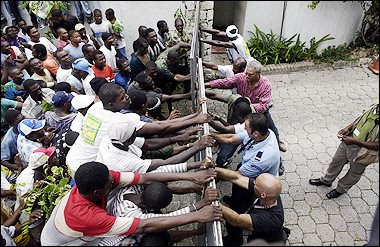
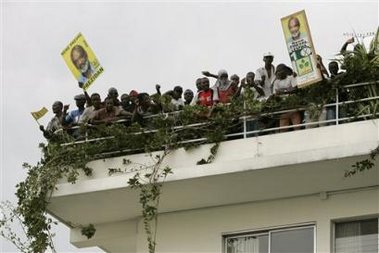
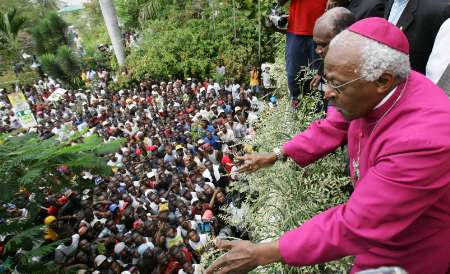
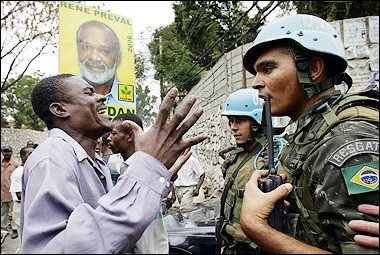
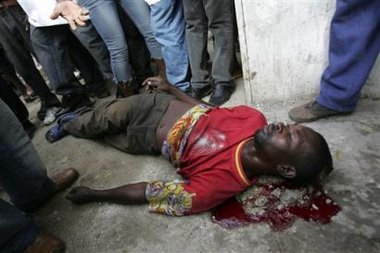
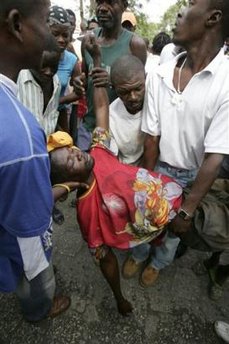
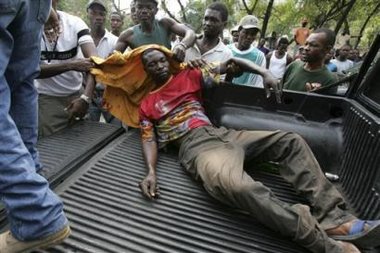
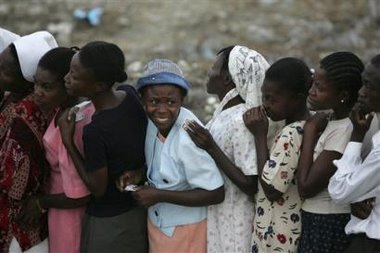
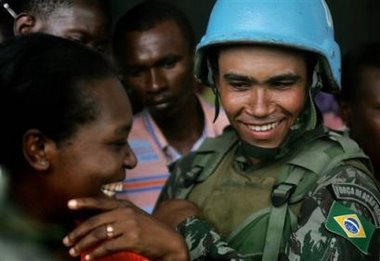
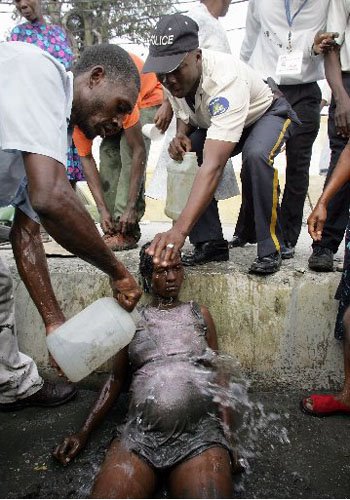
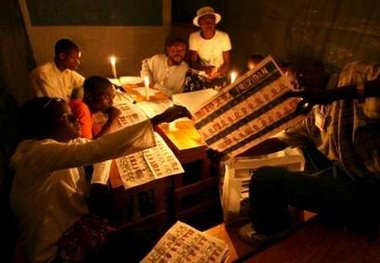
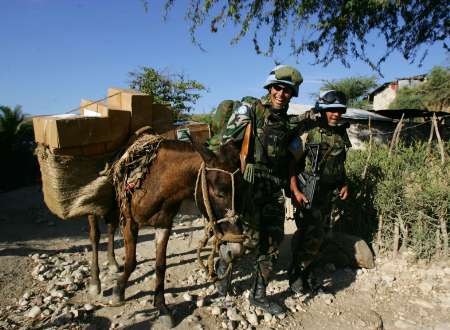
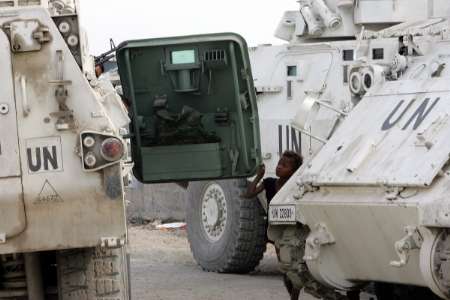
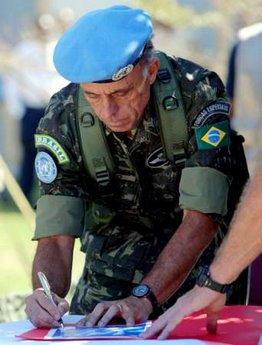
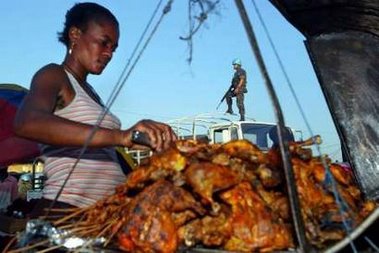
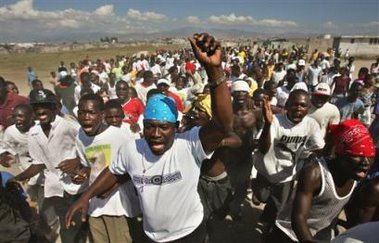
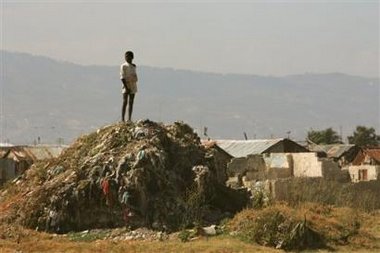
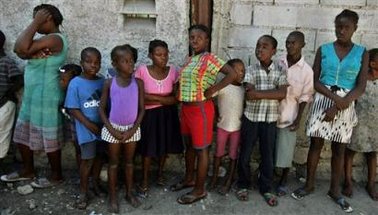
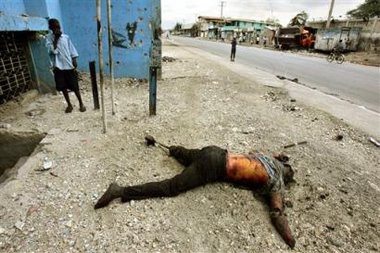
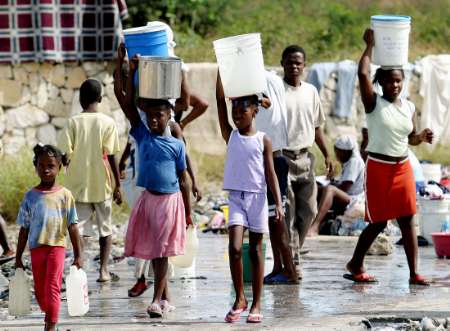
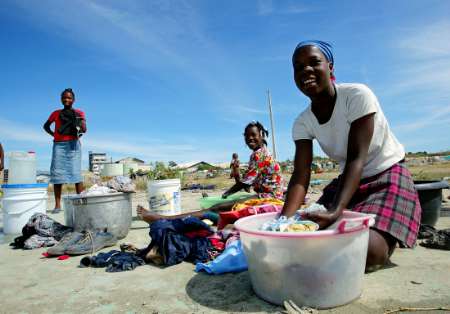
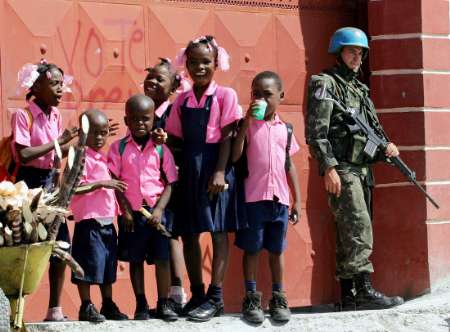
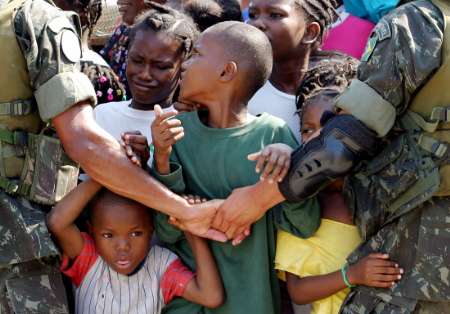
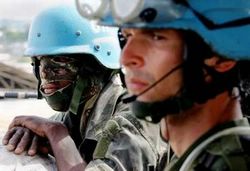
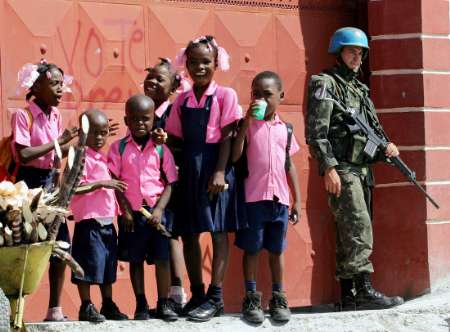
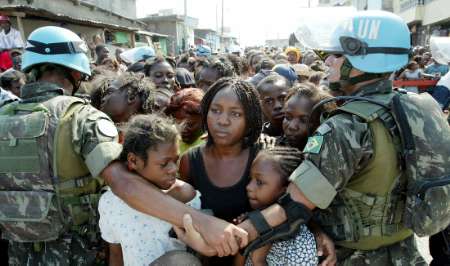
Everything gets muddy, but the seminal moment, the inception, of this post was seeing these photographs and finding strength and gentleness so evident in the Brasilian soldiers, particularly in their hands. It made me want to say again: Braço Forte - Mão Amiga, é, verdade!

Look carefully at the hands in all of these pictures, especially the last one. See at the way the two men are holding on to one another, and then look at the way the little kid has his hands on the soldier's arm and the little girl with her hand on the other one's hip.
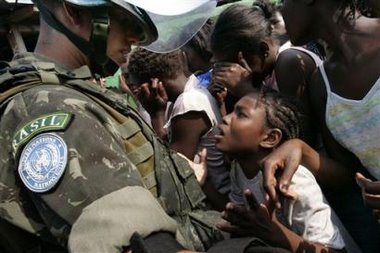
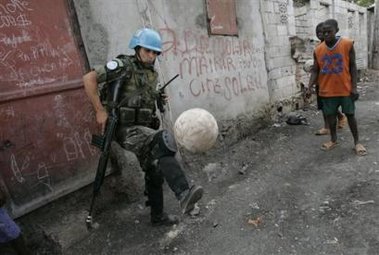
United Nations Stabilization Mission in Haiti (MINUSTAH)

Alabama - Neil Young
Oh Alabama
The devil fools with the best laid plan.
Swing low Alabama
You got the spare change
You got to feel strange
And now the moment is all that it meant.

Alabama, you got the weight on your shoulders
That's breaking your back.
Your Cadillac has got a wheel in the ditch
And a wheel on the track

Oh Alabama
Banjos playing through the broken glass
Windows down in Alabama.
See the old folks tied in white ropes
Hear the banjo.
Don't it take you down home?

Oh Alabama.
Can I see you and shake your hand.
Make friends down in Alabama.
I'm from a new land
I come to you and see all this ruin
What are you doing Alabama?
You got the rest of the union to help you along
What's going wrong?

Of course it is not apt - I put Neil's song here because it operates at a certain level, the same place as the thoughts I have about these photographs. Maybe there are things that people who know what it means to live in a favela understand better than soi-distant bourgeois intellectuals. I included Jordan, although I don't know much about the place, because it was a Jordanian who died today, Capt. Yousef Mubark Muflih Algader.
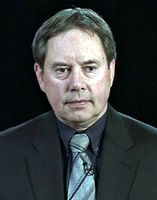
Toronto Star: Jordanian peacekeeper killed in Haiti. Reuters: Jordanian UN peacekeeper killed in Haiti. And a Canadian was killed recently too, Mark Bourque.

Tags: , , , , , , , , , , .

Segunda-feira, Dezembro 26, 2005

Tsunami & Dragonflies

See just this Post & Comments / 1 Comments so far / Post a Comment /   Home
Up, Down.

Names we never heard before:


The wave coming ashore at Ao Nang.


Before and after shots of a portion of Banda Aceh, a small city on the northern tip of Sumatra.


A man named Halimuddin sits on the remains of his boat with his son, having lost his wife and 7 children.

Almost a year later Acehnese women are carrying baskets of fertiliser on their heads and planting mangrove trees in Tibang village near Banda Aceh. Planting mangroves turns out to be a pretty good idea. Nature has a good overview of the specific problems encountered in Kajhu, another small community in Aceh, centering on the relationship between immediate hard cash and long-term responsibility: Natural disasters: Roots of recovery, unfortunately it is a pay-per-view so I will see about popping the contents into a comment.

They are paid wages for the work by aid agencies: AP - Aceh a testament to aid successes and failures.

Anniversary memorial at Khao Lak, Thailand.


Tilly Smith of Britain, 11 years old was dubbed the "angel of the beach." From Oxshott, Surrey, she was holidaying with her parents and seven-year-old sister on Maikhao beach in Phuket, Thailand, when the tide rushed out. As the other tourists watched in amazement, the water began to bubble and the boats on the horizon started to violently bob up and down.

Tilly, who had studied tsunamis in a geography class two weeks earlier, quickly realised they were in danger. She told her mother they had to get off the beach immediately and warned that it could be a tsunami. She explained she had just completed a school project on the huge waves and said they were seeing the warning signs that a tsunami was minutes away. Her parents alerted the other holidaymakers and staff on the beach, which was quickly evacuated. The wave crashed a few minutes later, but no one on the beach was killed or seriously injured.

Tilly gave the credit to her geography teacher, Andrew Kearney, at Oxshott's Danes Hill Prep School. She said "Last term Mr Kearney taught us about earthquakes and how they can cause tsunamis. "I was on the beach and the water started to go funny. There were bubbles and the tide went out all of a sudden. "I recognised what was happening and had a feeling there was going to be a tsunami. I told mummy."


Migrant workers from Myanmar help rebuild Ban Nam Khem village in Thailand's Phang Nga Province, nearly 80 miles north of the Thai island of Phuket. Thousands of illegal migrant workers from Myanmar still dare not search for relatives believed killed in last year's tsunami in Thailand because they fear expulsion.

Down.

Domingo, Dezembro 25, 2005

For unto us a child is born

See just this Post & Comments / 0 Comments so far / Post a Comment /   Home
Next, Back.
paz
e
amor


For unto us a child is born, unto us a son is given: and the government shall be upon his shoulder: and his name shall be called Wonderful, Counsellor, The mighty God, The everlasting Father, The Prince of Peace.
Isaiah 9-6.

Pois já nos nasceu um menino, um filho se nos deu; o governo está sobre os seus ombros; e o seu nome será: Maravilhoso, Conselheiro, Deus Forte, Pai da Eternidade, Príncipe da Paz; Isaías 9:6

When the chorous singing Handel's Messiah gets to "WONDERFUL !", Christmas begins for me.

Peace on Earth, Goodwill to men. Or, "to all people" if you like, what ever.

Merry Christmas to anyone who passes this way, and to EVERYONE (every single one).


"God bless us every one!" said Tiny Tim, the last of all.

Good King Wenceslas - John Mason Neale

Good King Wenceslas looked out on the Feast of Stephen,
When the snow lay round about, deep and crisp and even.
Brightly shone the moon that night, though the frost was cruel,
When a poor man came in sight, gathering winter fuel.

“Hither, page, and stand by me, if you knowst it, telling,
Yonder peasant, who is he? What and where his dwelling?”
“Sire, he lives a good league hence, underneath the mountain,
Right against the forest fence, by Saint Agnes’ fountain.”

“Bring me food and bring me wine, bring me pine logs hither,
You and I will see him dine, when we bear them thither.”
Page and monarch, forth they went, forth they went together,
Through the cold wind’s wild lament and the bitter weather.

“Sire, the night is darker now, and the wind blows stronger,
Fails my heart, I know not how; I can go no longer.”
“Mark my footsteps, my good page, tread thou in them boldly,
You shall find the winter’s rage freeze your blood less coldly.”

In his master’s steps he trod, where the snow lay dinted;
Heat was in the very sod which the saint had printed.
Therefore, Christian men, be sure, wealth or rank possessing,
You who now will bless the poor shall yourselves find blessing.

Click to Enlarge / Click para Aumentar

This is, to me, the very best carol. It never fails to move me, even some tinny midi file. I sometimes change the last two lines to:

Therefore, Christian men be sure, love the Lord thy maker
And as thou dost love thyself, love also thy neighbour.


Tags: , , , , .

Quinta-feira, Dezembro 22, 2005

Righteous Anger - Kingfisher

See just this Post & Comments / 0 Comments so far / Post a Comment /   Home
Up, Down, Thread Ahead: Elihu - Kingfisher continued, Thread Back: None.

"Nothing comes to the wronged so easily as righteous anger." (next)

The anonomous author of an article in Economist: Intellectual property, The real lesson of BlackBerry appears to have coined the phrase - Google gives me no other references. Interesting. I jotted it down as I was reading the article and I have now come back to my jotting.

The hop-skip-and-jump of it is worthy of Gerald Manley Hopkins' sprung rhythm:

AS kingfishers catch fire, dragonflies dráw fláme;
As tumbled over rim in roundy wells
Stones ring; like each tucked string tells, each hung bell’s
Bow swung finds tongue to fling out broad its name;
Each mortal thing does one thing and the same:
Deals out that being indoors each one dwells;
Selves - goes itself; myself it speaks and spells,
Crying Whát I do is me: for that I came.

Í say móre: the just man justices;
Kéeps gráce: thát keeps all his goings graces;
Acts in God’s eye what in God’s eye he is -
Chríst - for Christ plays in ten thousand places,
Lovely in limbs, and lovely in eyes not his
To the Father through the features of men’s faces.

Pretentious nonsense though, it seems to me, looking seriously at it. Of course the wronged are righteously angry, little matter if it be their first or second or third response. But this article is about a group who have nothing to be righteously angry about, who are not wronged, although they may feel that they have been. So the implication, in (either) the hyper-correct mind of the anonymous author (or) simply through slipshod thinking/writing/editing, is that there is something wrong with raging when you are wronged? No Lear? No Titus Andronicus?

Have I stumbled on something here? Is the true source of all of this bureaucratic correctitude nothing more than slipshod thinking repeated?

Kingfisher

Ceyx and Alcyone (back next)
Ovid, Metamorphoses, Book 11 Summary

After Ceyx' brother, Daedalion, is turned to a hawk, Ceyx departs to visit the oracle of Apollo. Alcyone, his wife, is afraid for his safety, but after a tearful goodbye, and promising to return, he sails off to the oracle. A storm wrecks the ship, drowning all on board. Before death, Ceyx prays that he will wash up on his native shore so that he can return to his wife as promised.

Alcyone does not know that her husband is dead, and prays to Juno for his safety. Juno sends her messenger, Iris, to make Sleep break the bad news in a dream. Alcyone is heartbroken, and as she stands on the shore she sees Ceyx' body floating on the waves. She rushes over the water to reach him and is changed into a kingfisher. Ceyx is transformed also and they live out their lives on the sea, even raising their young on the waves.

Juno sees to it that their breeding season is protected from storms - the 14 Halcyon Days around the Winter Solstice.

Ceyx and Alcyone (back next)
Ovid, Metamorphoses, Book 11

These prodigies affect the pious prince,
But more perplex'd with those that happen'd since,
He purposes to seek the Clarian God,
Avoiding Delphi, his more fam'd abode,
Since Phlegyan robbers made unsafe the road.
Yet could he not from her he lov'd so well,
The fatal voyage, he resolv'd, conceal;
But when she saw her lord prepar'd to part,
A deadly cold ran shiv'ring to her heart;
Her faded cheeks are chang'd to boxen hue,
And in her eyes the tears are ever new.
She thrice essay'd to speak; her accents hung,
And falt'ring dy'd unfinish'd on her tongue,
And vanish'd into sighs: with long delay
Her voice return'd, and found the wonted way.

Tell me, my lord, she said, what fault unknown
Thy once belov'd Alcyone has done?
Whither, ah, whither, is thy kindness gone!
Can Ceyx then sustain to leave his wife,
And unconcern'd forsake the sweets of life?
What can thy mind to this long journey move?
Or need'st thou absence to renew thy love?
Yet, if thou go'st by land, tho' grief possess
My soul ev'n then, my fears will be the less.
But ah! be warn'd to shun the watry way,
The face is frightful of the stormy sea:
For late I saw a-drift disjointed planks,
And empty tombs erected on the banks.
Nor let false hopes to trust betray thy mind,
Because my sire in caves constrains the wind,
Can with a breath their clam'rous rage appease,
They fear his whistle, and forsake the seas:
Not so; for once indulg'd, they sweep the main;
Deaf to the call, or hearing, hear in vain;
But bent on mischief bear the waves before,
And not content with seas, insult the shore,
When ocean, air, and Earth, at once ingage,
And rooted forests fly before their rage:
At once the clashing clouds to battel move,
And lightnings run across the fields above:
I know them well, and mark'd their rude comport,
While yet a child within my father's court:
In times of tempest they command alone,
And he but sits precarious on the throne:
The more I know, the more my fears augment;
And fears are oft prophetick of th' event.
But if not fears, or reasons will prevail,
If Fate has fix'd thee obstinate to sail,
Go not without thy wife, but let me bear
My part of danger with an equal share,
And present, what I suffer only fear:
Then o'er the bounding billows shall we fly,
Secure to live together, or to die.

These reasons mov'd her warlike husband's heart,
But still he held his purpose to depart:
For as he lov'd her equal to his life,
He would not to the seas expose his wife;
Nor could be wrought his voyage to refrain,
But sought by arguments to sooth her pain:
Nor these avail'd; at length he lights on one,
With which so difficult a cause he won:
My love, so short an absence cease to fear,
For by my father's holy flame I swear,
Before two moons their orb with light adorn,
If Heav'n allow me life, I will return.

This promise of so short a stay prevails;
He soon equips the ship, supplies the sails,
And gives the word to launch; she trembling views
This pomp of death, and parting tears renews:
Last with a kiss, she took a long farewel,
Sigh'd with a sad presage, and swooning fell:
While Ceyx seeks delays, the lusty crew,
Rais'd on their banks, their oars in order drew
To their broad breasts, the ship with fury flew.

The queen recover'd, rears her humid eyes,
And first her husband on the poop espies,
Shaking his hand at distance on the main;
She took the sign, and shook her hand again.
Still as the ground recedes, contracts her view
With sharpen'd sight, 'till she no longer knew
The much-lov'd face; that comfort lost supplies
With less, and with the galley feeds her eyes;
The galley born from view by rising gales,
She follow'd with her sight the flying sails:
When ev'n the flying sails were seen no more,
Forsaken of all sight she left the shore.

Then on her bridal bed her body throws,
And sought in sleep her wearied eyes to close:
Her husband's pillow, and the widow'd part
Which once he press'd, renew'd the former smart.

And now a breeze from shoar began to blow,
The sailors ship their oars, and cease to row;
Then hoist their yards a-trip, and all their sails
Let fall, to court the wind, and catch the gales:
By this the vessel half her course had run,
Both shoars were lost to sight, when at the close
Of day a stiffer gale at east arose:
The sea grew white, the rouling waves from far,
Like heralds, first denounce the watry war.

This seen, the master soon began to cry,
Strike, strike the top-sail; let the main-sheet fly,
And furl your sails: the winds repel the sound,
And in the speaker's mouth the speech is drown'd.
Yet of their own accord, as danger taught
Each in his way, officiously they wrought;
Some stow their oars, or stop the leaky sides,
Another bolder, yet the yard bestrides,
And folds the sails; a fourth with labour laves
Th' intruding seas, and waves ejects on waves.

In this confusion while their work they ply,
The winds augment the winter of the sky,
And wage intestine wars; the suff'ring seas
Are toss'd, and mingled, as their tyrants please.
The master would command, but in despair
Of safety, stands amaz'd with stupid care,
Nor what to bid, or what forbid he knows,
Th' ungovern'd tempest to such fury grows:
Vain is his force, and vainer is his skill;
With such a concourse comes the flood of ill;
The cries of men are mix'd with rattling shrowds;
Seas dash on seas, and clouds encounter clouds:
At once from east to west, from pole to pole,
The forky lightnings flash, the roaring thunders roul.

Now waves on waves ascending scale the skies,
And in the fires above the water fries:
When yellow sands are sifted from below,
The glittering billows give a golden show:
And when the fouler bottom spews the black
The Stygian dye the tainted waters take:
Then frothy white appear the flatted seas,
And change their colour, changing their disease,
Like various fits the Trachin vessel finds,
And now sublime, she rides upon the winds;
As from a lofty summit looks from high,
And from the clouds beholds the nether sky;
Now from the depth of Hell they lift their sight,
And at a distance see superior light;
The lashing billows make a loud report,
And beat her sides, as batt'ring rams a fort:
Or as a lion bounding in his way,
With force augmented, bears against his prey,
Sidelong to seize; or unapal'd with fear,
Springs on the toils, and rushes on the spear:
So seas impell'd by winds, with added pow'r
Assault the sides, and o'er the hatches tow'r.

The planks (their pitchy cov'ring wash'd away)
Now yield; and now a yawning breach display:
The roaring waters with a hostile tide
Rush through the ruins of her gaping side.
Mean-time in sheets of rain the sky descends,
And ocean swell'd with waters upwards tends;
One rising, falling one, the Heav'ns and sea
Meet at their confines, in the middle way:
The sails are drunk with show'rs, and drop with rain,
Sweet waters mingle with the briny main.
No star appears to lend his friendly light;
Darkness, and tempest make a double night;
But flashing fires disclose the deep by turns,
And while the lightnings blaze, the water burns.

Now all the waves their scatter'd force unite,
And as a soldier foremost in the fight,
Makes way for others, and an host alone
Still presses on, and urging gains the town;
So while th' invading billows come a-breast,
The hero tenth advanc'd before the rest,
Sweeps all before him with impetuous sway,
And from the walls descends upon the prey;
Part following enter, part remain without,
With envy hear their fellows' conqu'ring shout,
And mount on others' backs, in hopes to share
The city, thus become the seat of war.

An universal cry resounds aloud,
The sailors run in heaps, a helpless crowd;
Art fails, and courage falls, no succour near;
As many waves, as many deaths appear.
One weeps, and yet despairs of late relief;
One cannot weep, his fears congeal his grief,
But stupid, with dry eyes expects his fate:
One with loud shrieks laments his lost estate,
And calls those happy whom their fun'rals wait.
This wretch with pray'rs and vows the Gods implores,
And ev'n the skies he cannot see, adores.
That other on his friends his thoughts bestows,
His careful father, and his faithful spouse.
The covetous worldling in his anxious mind,
Thinks only on the wealth he left behind.

All Ceyx his Alcyone employs,
For her he grieves, yet in her absence joys:
His wife he wishes, and would still be near,
Not her with him, but wishes him with her:
Now with last looks he seeks his native shoar,
Which Fate has destin'd him to see no more;
He sought, but in the dark tempestuous night
He knew not whither to direct his sight.
So whirl the seas, such darkness blinds the sky,
That the black night receives a deeper dye.

The giddy ship ran round; the tempest tore
Her mast, and over-board the rudder bore.
One billow mounts, and with a scornful brow,
Proud of her conquest gain'd, insults the waves below;
Nor lighter falls, than if some giant tore
Pindus and Athos with the freight they bore,
And toss'd on seas; press'd with the pond'rous blow,
Down sinks the ship within th' abyss below:
Down with the vessel sink into the main
The many, never more to rise again.
Some few on scatter'd planks, with fruitless care,
Lay hold, and swim; but while they swim, despair.

Ev'n he who late a scepter did command,
Now grasps a floating fragment in his hand;
And while he struggles on the stormy main,
Invokes his father, and his wife's, in vain.
But yet his consort is his greatest care,
Alcyone he names amidst his pray'r;
Names as a charm against the waves and wind;
Most in his mouth, and ever in his mind.
Tir'd with his toil, all hopes of safety past,
From pray'rs to wishes he descends at last;
That his dead body, wafted to the sands,
Might have its burial from her friendly hands,
As oft as he can catch a gulp of air,
And peep above the seas, he names the fair;
And ev'n when plung'd beneath, on her he raves,
Murm'ring Alcyone below the waves:
At last a falling billow stops his breath,
Breaks o'er his head, and whelms him underneath.
That night, his heav'nly form obscur'd with tears,
And since he was forbid to leave the skies,
He muffled with a cloud his mournful eyes.

Mean-time Alcyone (his fate unknown)
Computes how many nights he had been gone.
Observes the waining moon with hourly view,
Numbers her age, and wishes for a new;
Against the promis'd time provides with care,
And hastens in the woof the robes he was to wear:
And for her self employs another loom,
New-dress'd to meet her lord returning home,
Flatt'ring her heart with joys, that never were to come:
She fum'd the temples with an od'rous flame,
And oft before the sacred altars came,
To pray for him, who was an empty name.
All Pow'rs implor'd, but far above the rest
To Juno she her pious vows address'd,
Her much-lov'd lord from perils to protect,
And safe o'er seas his voyage to direct:
Then pray'd, that she might still possess his heart,
And no pretending rival share a part;
This last petition heard of all her pray'r,
The rest, dispers'd by winds, were lost in air.

But she, the Goddess of the nuptial bed,
Tir'd with her vain devotions for the dead,
Resolv'd the tainted hand should be repell'd,
Which incense offer'd, and her altar held:
Then Iris thus bespoke: Thou faithful maid,
By whom thy queen's commands are well convey'd,
Haste to the house of sleep, and bid the God
Who rules the night by visions with a nod,
Prepare a dream, in figure, and in form
Resembling him, who perish'd in the storm;
This form before Alcyone present,
To make her certain of the sad event.

Indu'd with robes of various hue she flies,
And flying draws an arch (a segment of the skies):
Then leaves her bending bow, and from the steep
Descends, to search the silent house of sleep.

The House of Sleep

Near the Cymmerians, in his dark abode,
Deep in a cavern, dwells the drowzy God;
Whose gloomy mansion nor the rising sun,
Nor setting, visits, nor the lightsome noon;
But lazy vapours round the region fly,
Perpetual twilight, and a doubtful sky:
No crowing cock does there his wings display,
Nor with his horny bill provoke the day;
Nor watchful dogs, nor the more wakeful geese,
Disturb with nightly noise the sacred peace;
Nor beast of Nature, nor the tame are nigh,
Nor trees with tempests rock'd, nor human cry;
But safe repose without an air of breath
Dwells here, and a dumb quiet next to death.

An arm of Lethe, with a gentle flow
Arising upwards from the rock below,
The palace moats, and o'er the pebbles creeps,
And with soft murmurs calls the coming sleeps.
Around its entry nodding poppies grow,
And all cool simples that sweet rest bestow;
Night from the plants their sleepy virtue drains,
And passing, sheds it on the silent plains:
No door there was th' unguarded house to keep,
On creaking hinges turn'd, to break his sleep.

But in the gloomy court was rais'd a bed,
Stuff'd with black plumes, and on an ebon-sted:
Black was the cov'ring too, where lay the God,
And slept supine, his limbs display'd abroad:
About his head fantastick visions fly,
Which various images of things supply,
And mock their forms; the leaves on trees not more,
Nor bearded ears in fields, nor sands upon the shore.

The virgin ent'ring bright, indulg'd the day
To the brown cave, and brush'd the dreams away:
The God disturb'd with this new glare of light,
Cast sudden on his face, unseal'd his sight,
And rais'd his tardy head, which sunk again,
And sinking, on his bosom knock'd his chin;
At length shook off himself, and ask'd the dame,
(And asking yawn'd) for what intent she came.

To whom the Goddess thus: O sacred rest,
Sweet pleasing sleep, of all the Pow'rs the best!
O peace of mind, repairer of decay,
Whose balms renew the limbs to labours of the day,
Care shuns thy soft approach, and sullen flies away!
Adorn a dream, expressing human form,
The shape of him who suffer'd in the storm,
And send it flitting to the Trachin court,
The wreck of wretched Ceyx to report:
Before his queen bid the pale spectre stand,
Who begs a vain relief at Juno's hand.
She said, and scarce awake her eyes could keep,
Unable to support the fumes of sleep;
But fled, returning by the way she went,
And swerv'd along her bow with swift ascent.

The God, uneasy 'till he slept again,
Resolv'd at once to rid himself of pain;
And, tho' against his custom, call'd aloud,
Exciting Morpheus from the sleepy crowd:
Morpheus, of all his numerous train, express'd
The shape of man, and imitated best;
The walk, the words, the gesture could supply,
The habit mimick, and the mein bely;
Plays well, but all his action is confin'd,
Extending not beyond our human kind.
Another, birds, and beasts, and dragons apes,
And dreadful images, and monster shapes:
This demon, Icelos, in Heav'n's high hall
The Gods have nam'd; but men Phobetor call.
A third is Phantasus, whose actions roul
On meaner thoughts, and things devoid of soul;
Earth, fruits, and flow'rs he represents in dreams,
And solid rocks unmov'd, and running streams.
These three to kings, and chiefs their scenes display,
The rest before th' ignoble commons play.
Of these the chosen Morpheus is dispatch'd;
Which done, the lazy monarch, over-watch'd,
Down from his propping elbow drops his head,
Dissolv'd in sleep, and shrinks within his bed.

Darkling the demon glides, for flight prepar'd,
So soft, that scarce his fanning wings are heard.
To Trachin, swift as thought, the flitting shade,
Thro' air his momentary journey made:
Then lays aside the steerage of his wings,
Forsakes his proper form, assumes the king's;
And pale, as death, despoil'd of his array,
Into the queen's apartment takes his way,
And stands before the bed at dawn of day:
Unmov'd his eyes, and wet his beard appears;
And shedding vain, but seeming real tears;
The briny waters dropping from his hairs.
Then staring on her with a ghastly look,
And hollow voice, he thus the queen bespoke.

Know'st thou not me? Not yet, unhappy wife?
Or are my features perish'd with my life?
Look once again, and for thy husband lost,
Lo all that's left of him, thy husband's ghost!
Thy vows for my return were all in vain,
The stormy south o'ertook us in the main,
And never shalt thou see thy living lord again.
Bear witness, Heav'n, I call'd on thee in death,
And while I call'd, a billow stop'd my breath.
Think not, that flying fame reports my fate;
I present, I appear, and my own wreck relate.
Rise, wretched widow, rise; nor undeplor'd
Permit my soul to pass the Stygian ford;
But rise, prepar'd in black, to mourn thy perish'd lord.

Thus said the player-God; and adding art
Of voice and gesture, so perform'd his part,
She thought (so like her love the shade appears)
That Ceyx spake the words, and Ceyx shed the tears;
She groan'd, her inward soul with grief opprest,
She sigh'd, she wept, and sleeping beat her breast;
Then stretch'd her arms t' embrace his body bare;
Her clasping arms inclose but empty air:
At this, not yet awake, she cry'd, O stay;
One is our fate, and common is our way!

So dreadful was the dream, so loud she spoke,
That starting sudden up, the slumber broke:
Then cast her eyes around, in hope to view
Her vanish'd lord, and find the vision true:
For now the maids, who waited her commands,
Ran in with lighted tapers in their hands.
Tir'd with the search, not finding what she seeks,
With cruel blows she pounds her blubber'd cheeks;
Then from her beaten breast the linnen tare,
And cut the golden caul that bound her hair.
Her nurse demands the cause; with louder cries
She prosecutes her griefs, and thus replies.

No more Alcyone; she suffer'd death
With her lov'd lord, when Ceyx lost his breath:
No flatt'ry, no false comfort, give me none,
My shipwreck'd Ceyx is for ever gone:
I saw, I saw him manifest in view,
His voice, his figure, and his gestures knew:
His lustre lost, and ev'ry living grace,
Yet I retain'd the features of his face;
Tho' with pale cheeks, wet beard, and dropping hair,
None but my Ceyx could appear so fair:
I would have strain'd him with a strict embrace,
But thro' my arms he slipt, and vanish'd from the place:
There, ev'n just there he stood; and as she spoke,
Where last the spectre was she cast her look:
Fain would she hope, and gaz'd upon the ground,
If any printed footsteps might be found.

Then sigh'd, and said: This I too well foreknew,
And my prophetick fears presag'd too true:
'Twas what I begg'd, when with a bleeding heart
I took my leave, and suffer'd thee to part;
Or I to go along, or thou to stay,
Never, ah never to divide our way!
Happier for me, that all our hours assign'd
Together we had liv'd; ev'n not in death disjoin'd!
So had my Ceyx still been living here,
Or with my Ceyx I had perish'd there:
Now I die absent, in the vast profound;
And me, without my self, the seas have drown'd.
The storms were not so cruel: should I strive
To lengthen life, and such a grief survive;
But neither will I strive, nor wretched thee
In death forsake, but keep thee company.
If not one common sepulchre contains
Our bodies, or one urn our last remains,
Yet Ceyx and Alcyone shall join,
Their names remember'd in one common line.

No farther voice her mighty grief affords,
For sighs come rushing in betwixt her words,
And stop'd her tongue; but what her tongue deny'd,
Soft tears, and groans, and dumb complaints supply'd.

'Twas morning; to the port she takes her way,
And stands upon the margin of the sea:
That place, that very spot of ground she sought,
Or thither by her destiny was brought,
Where last he stood: and while she sadly said,
'Twas here he left me, lingring here delay'd
His parting kiss, and there his anchors weigh'd.

Thus speaking, while her thoughts past actions trace,
And call to mind, admonish'd by the place,
Sharp at her utmost ken she cast her eyes,
And somewhat floating from afar descries:
It seems a corps a-drift to distant sight,
But at a distance who could judge aright?
It wafted nearer yet, and then she knew,
That what before she but surmis'd, was true:
A corps it was, but whose it was, unknown,
Yet mov'd, howe'er, she made the cause her own.
Took the bad omen of a shipwreck'd man,
As for a stranger wept, and thus began.

Poor wretch, on stormy seas to lose thy life,
Unhappy thou, but more thy widow'd wife;
At this she paus'd: for now the flowing tide
Had brought the body nearer to the side:
The more she looks, the more her fears increase,
At nearer sight; and she's her self the less:
Now driv'n ashore, and at her feet it lies,
She knows too much in knowing whom she sees:
Her husband's corps; at this she loudly shrieks,
'Tis he, 'tis he, she cries, and tears her cheeks,
Her hair, and vest; and stooping to the sands,
About his neck she cast her trembling hands.

And is it thus, o dearer than my life,
Thus, thus return'st thou to thy longing wife!
She said, and to the neighbouring mole she strode,
(Rais'd there to break th' incursions of the flood).

Headlong from hence to plunge her self she springs,
But shoots along, supported on her wings;
A bird new-made, about the banks she plies,
Not far from shore, and short excursions tries;
Nor seeks in air her humble flight to raise,
Content to skim the surface of the seas:
Her bill tho' slender, sends a creaking noise,
And imitates a lamentable voice.
Now lighting where the bloodless body lies,
She with a fun'ral note renews her cries:
At all her stretch, her little wings she spread,
And with her feather'd arms embrac'd the dead:
Then flick'ring to his palid lips, she strove
To print a kiss, the last essay of love.
Whether the vital touch reviv'd the dead,
Or that the moving waters rais'd his head
To meet the kiss, the vulgar doubt alone;
For sure a present miracle was shown.
The Gods their shapes to winter-birds translate,
But both obnoxious to their former fate.
Their conjugal affection still is ty'd,
And still the mournful race is multiply'd:
They bill, they tread; Alcyone compress'd,
Sev'n days sits brooding on her floating nest:
A wintry queen: her sire at length is kind,
Calms ev'ry storm, and hushes ev'ry wind;
Prepares his empire for his daughter's ease,
And for his hatching nephews smooths the seas.

Okishkimonisse Saves the Summer Birds (back next)

A great many years ago, a giant found that he could make the winter stay in the north country all year long if he put the birds of summer in cages. When the time came for the weather to turn warm, there was no change. It stayed very, very cold. There were no wrens or robins, no woodpeckers, larks, finches, nor any of the other birds that returned to the land of the Ojibwe during the spring and summer.

In the north, the Ojibwe people were in misery. All they could think of were the warm summer months, as they shivered all day long in the cold. There was very little food left. The animals tried to eat bark from the aspen tree as they had seen the beaver do, but they discovered this was a poor substitute for their regular diets. Finally, the people and the animals gathered together in Council.

They were determined to find the summer birds and make them return to the north, bringing the summer weather with them. However, out of all the men and animals, it was the small Kingfisher, Okishkimonisse, who finally offered to go and find the one causing all these problems and bring the summer birds back home.

The next day, Okishkimonisse started out on his journey, taking only a small ball of wax to use as a weapon. Day after day, he flew southward, the direction he had watched the summer birds fly when they left the year before. He traveled a full moon before he finally reached the home of the giant. The giant was asleep when Okishkimonisse arrived, but he had posted two crows as guards.

Now, Okishkimonisse was able to move quietly, and before the crows knew it, the Kingfisher had dropped down on them, clamped their bills shut, and sealed them tightly with the ball of wax. This kept the crows from calling out to the giant.

Then quietly, so as to not make a sound, Okishkimonisse crept inside to where the cages of the summer birds were kept. One by one, he opened the bird's cages. The birds tested their wings after their long captivity and as soon as they began to fan the air, it began to get warm. The snow melted and the plants began to break through the earth. As the birds flew northward, they brought summer to the waiting people along the way. When the birds finally arrived in the north country, the Ojibwe people knew that the Kingfisher had succeeded in his mission.

Now, the giant had slept through all of this. But, eventually, the summer's heat had caused the wax on the crow's bills to melt. Then the Crows called out to their master. "The summer birds!" they cawed. "Okishkimonisse has opened their cages and let them all escape!"

The giant was up in an instant and was soon chasing Okishkimonisse with his bow and arrow. He chased the fisher up a rocky hillside, overlooking a beautiful green valley. When he reached the edge of the cliff, the fisher jumped and flew toward the sky. The giant followed, aiming his arrow as he left the ground. The arrow hit the bird, but only wounded him.

Today, the fisher flies high in the sky, but he still has a crooked tail.

Andaman and Nicobar Islands, Bay of Bengal (back next)

After Puluga had made the world, he created man and called him Tomo. He was black in color like his modern-day descendants but much taller and bearded. Puluga showed Tomo how to use fire, but not directly.

Some say it was Prawn who first obtained fire. Some yam leaves, being shriveled and dry, caught fire in the sun and burnt. Prawn made a bigger fire by adding some firewood and went to sleep. But Kingfisher stole the fire and ran away with it. He made a fire and cooked some fish. When he had filled his belly, he went to sleep. Then Dove stole the fire from Kingfisher while he slept and ran away. It was Dove, the last of the thieves, who gave the fire to Tomo, the ancestor of the people.

Still, the people could not make fire themselves but had to nurse it carefully in special containers they carried around with them on their frequent wanderings. If the fire was allowed to go out through carelessness or accident, a new flame had to be sought from a friendly neighboring tribe, which was embarrassing, or a natural fire caused by lighting had to be awaited.

Some say that one day Tomo shot an arrow at a hill of fire, a volcano, whereupon the arrow burst into flames. The burning arrow was found and brought back to camp by Kingfisher, but he refused to share the fire with the people. After asking for it in vain, the people stole it from kingfisher and kept it for themselves.

Fire was saved from the flood by Monitor Lizard and Civet Cat. When Monitor Lizard found that he could not carry the fire up a tree, his wife Civet Cat took it from him and carried it to the top of the hill where she kept it safe until the rain and flood had stopped.

Puluga also showed Tomo how to cook pigs which in those days were easy to catch as they had neither ears nor noses. Later Puluga created a woman whose name was Chan Elewadi. Tomo and Chan Elewadi had two daughters and two sons. When pigs became plentiful enough to be a nuisance, the clever woman drilled holes into their snouts and heads, thereby enabling them to hear and see to avoid danger and procure food for themselves. Puluga then covered the whole land with jungle in which the newly-equipped pigs could hide, thereby becoming much more difficult to catch. Puluga came to the rescue of the people by showing Tomo how to hunt with the help of bow and arrows as well as how to build canoes and how to fish. He showed Chan Elewadi how to weave baskets, make fishing nets and to use ochre and white clay. He also set down a number of rules and regulations such as a prohibition on noisy work at night during the wet season. Puluga also gave the people their language. In those days Puluga lived on Saddle Peak and being so near could visit and instruct his people. The canoes of those early days were not equipped with outriggers and were made of the hollowed out trunk of the pandanus tree which was said to have grown much bigger then. Tomo was said to have lived to a great old age and to have seen his descendants increase in number to such a degree that the original homeland could no longer accommodate them all. Puluga then interfered again and had them all equipped with weapons, implements, fire and their own language before they scattered in pairs all over the country. Tomo and his wife later drowned and were turned into a whale and a small crab respectively.

Tomo's successor was his grandson, Kolwot, who distinguished himself by being the first to catch turtle. After Kolwot's death, the people became remiss of the commands given to them at the creation. Puluga ceased to visit them and then without further warning sent a devastating flood.

Only four people survived this flood: two men, Loralola and Poilola, and two women, Kalola and Rimalola. When they landed they found they had lost their fire and all living things had perished. Puluga then recreated the animals and plants but does not seem to have given any further instructions, nor did he return the fire to the survivors. They suffered grievously. At this critical moment, one of their recently-drowned friends reappeared in the form of a Kingfisher. He noticed their distress and flew up to the sky where he found Puluga seated beside his fire. He seized a burning log and tried to fly to earth with it. The Kingfisher dropped the log on Puluga who suffered burns and angrily hurled the log at the bird.

It missed its mark and instead fell near the four survivors people who thus had their problem solved for them.

After settling down to their reduced circumstances, the survivors began to entertain thoughts of revenge against Puluga who had killed all their friends. When they met Puluga one day they thought of killing him. Puluga himself talked them out of this when he made clear to them that he was too hard for their arrows and that if they tried to kill him, he would kill them all. He also explained to them that their people had brought the deluge upon themselves by their disobedience. Thus obedience and submission was restored. It was said that this was the last time Puluga rendered himself visible or held any communications with his people.

Why Coyote changed the course of the Coumbia River (back next)

Coyote had a tepee near the Sanpoil River. Kingfisher had a tepee there too. Four brothers, the Wolves, had a tepee there. So there were three tepees of them.

Kingfisher was having a hard time getting his fish. He could get little fishes, but not enough. They didn't suit Coyote, who expected Kingfisher to do his fishing for him.

The four brothers could get all the meat they wanted because they could kill a deer any time they wanted to. They had plenty of meat, and they gave Coyote plenty of meat. The four brothers, the Wolves, were Coyote's nephews. But Kingfisher ate no meat and he was having a hard time getting his fish.

Down at Celilo on the Columbia, four sisters had a fish trap. They wouldn't let any big fish come up the river. Finally Coyote said, "That won't do. I've got to get busy and see into that, so that everybody can have fish, not just the sisters. I'll have to take a trip down there and see what I can do."

It took him a long time to walk down to Celilo. Before he came to the house where the fish trap was, he tried to think how he would break the dam and bring the fish up without hurting the girls any and without fighting with them. How was he going to fool them! Then he made his powers.

He asked his powers, "What can I do to get the fish up the river?"

His powers said to him, "Well, that's too much work. You can't do it."

"I can work all right," said Coyote, "if you will tell me what to do."

One of his powers said to him, "Go down a ways and get in the water and float down. You'll be a little wooden bowl. Go down on the trap. Then the sisters will see you and pick you up and take you back to the house."

So he went down to the water and turned into a little wooden bowl. When he got to the trap, he couldn't float any longer. So he stopped right there. When the sisters came down from the hills where they had been picking service berries, they went to look at the trap and to get some water. They got down there and saw the little wooden bowl in the trap.

One of them said, "O sisters, see this little wooden bowl! Now we can have a nice little dish to put our salmon in."

Two of her sisters ran up and said, "Isn't it pretty! Isn't it lovely!" But the youngest sister stood off at one side and said, "I don't think that wooden bowl is good for us. Better leave it alone. It might be something that will harm us." "Oh, you)re always suspicious," said one of her sisters. "What is the little bowl going to do! Someone must have tipped over in a canoe up above, and this is part of their stuff. It can't harm anyone. Let's take the wooden bowl to the house." That's what they did. So they cooked their salmon, ate all they wanted, and after supper put what was left into the little wooden bowl for breakfast. Then they put it behind their little pantry and went to bed.

The next morning when they got up, the wooden bowl was empty. There wasn't a thing in it. "I wonder what's happened to our salmon!" asked one of the sisters. "There isn't a thing in here." The youngest sister said, "I told you that wooden bowl isn't good for us. You wouldn't listen. We'd better throw it away." But the others said, "There must have been a rat or something that came and ate all the salmon. I don't think the dish had anything to do with it."

The youngest couldn't do anything with her sisters. There were three against one. So they cooked some more salmon, ate their fill, put what was left into the wooden bowl, and put it behind the pantry. Then they went up into the hills after more berries.

When they came back about one o'clock, they went to their house and looked at the little wooden bowl. But there wasn't anything in it. The youngest said, "I told you that bowl is no good for us." The others began to believe her and walked out of the house. The youngest had the bowl in her hand. She threw it against a big rock. Celilo was pretty rocky. The girl found a big rock and threw the bowl against it, to break it. When the bowl hit the rock, it dropped down on the ground and sat up as a little baby. One of the sisters ran over and picked it up. A little baby was staring at her.

"Oh, it's a little boy baby. Sisters, we'll have a brother now. We'll take care of him, and he'll grow up, and then he can get all the salmon for us. We won't have to get the salmon. All we'll have to do is to dry it and take care of it."

But the youngest sister said, "You'd better leave him alone. We don't want him in the house at all." But they were three against one. They took the baby up to the house. It was a cute little baby, full of smiles. It was always smiling. "Isn't he a cute little baby!" said the sisters. "Now we have a little brother."

So they fed it, put it in the bed in the tepee, and went back into the hills to pick berries. As soon as they were out of sight, Coyote changed himself from a little baby into a man. He went down and began digging and digging, to break the dam that they had worked so hard to make. When it was about time for the sisters to come back, he would go into the tepee, get into bed, and change himself into a baby.

Well, that went on for quite a few days. Every day he went on digging and digging. One day he said to himself, "Today I think I'll be able to break through this dam." He was working as hard as he could. "It's about time for them to come home, but I'll stay here and finish breaking the dam.

They can't harm me.", he thought, but nonetheless he had a wooden bowl which he put on top of his head. He kept on digging away and digging away. The sisters got back and went down after water. They saw him there, digging.

"Oh, he's a great big man, and he's breaking our trap!" cried one of the sisters. The youngest sister said, "You think you know it all. I told you that baby was no good for us."

They picked up a stick and ran over to him. They tried to hit him over the head. But he had on that wooden bowl, so they couldn't hurt him. He gave the dam a few more licks and it was broken through. Then he started running away from the girls.

He laughed at them. "You women never will put it over us men. Men always will put it over you."

When he walked away from them, the salmon followed him. When the dam was broken, the salmon went through the hole he had made. Coyote walked along the shore. Whenever he got hungry or tired, he would stop and call to some of the salmon in the river. A big salmon would lump out. He would catch it, roast it, eat it, and rest awhile. Whenever he stopped, the salmon stopped. So he kept coming up the river that way.

On the way down, he had stopped at the place where Dry Falls are now. At the time, the Columbia River flowed there. He had seen a family camping there and catching little fish to eat. They had two nice-looking girls. They looked good to him. He made up his mind that he would camp there and see what he could do.

He came there that evening and went to their tepee. The girls were out picking berries, so he talked to the old folks awhile. He said to the old man, "You'd better come down to the river with me. I saw a couple of salmon down there that you can have. So they went down there and caught one and brought it back and cooked it.

The girls came home. They all had a big feed on the salmon. He talked with them and then stayed over night. Next morning he went down and caught two more and brought them up to the old man. After breakfast Coyote asked the old folks if he could have the girls, to marry them.

"Well, I'll have to ask the girls," the old man said. So he asked them. "No," the girls said, "we don't want to be married yet. We want to be free for a while."

That made Coyote so angry that he broke up the river.

"All right. If you girls won't have me, you can go hungry the rest of your days. I'll just take the river away from you." So he changed the channel and made the river run down this other way, where it's running now. He said to the old man, "Some day there'll be some smart man who will run the river through here again. Years from now there will be one man who will make the water run this way again."

Then he came on up the river. He kept coming up, coming up, coming up the river till he reached the mouth of the Sanpoil River. A girl there looked good to him. He put in Hell Gate dam to hold the salmon back for her people. The salmon couldn't get over Hell Gate dam. It was too high; they couldn't get over it, the way he had it fixed.

But that girl wouldn't have him. So Coyote said, "Four or five kinds of salmon will come up the big river. King salmon will go up the big river, but no big ones will come up the Sanpoil River. Steelheads first, chinooks, then silver salmon, those little salmon smaller than the silver and red on the outside - those four kinds will go up the Sanpoil. But no king salmon - no big ones." Then he broke up the dam he had made at Hell Gate. Ever since then, there have been rocks and rapids at Hell Gate.

He went on up the river and took his salmon with him. He went and went and went and went. He got as far as Kettle Falls. Of course there were no falls there, but people were living on both sides of the river. And he saw a nice-looking girl there. She was one of the Beaver family, and she looked good to him in spite of her big teeth.

"I'm going to see what I can do here," Coyote said to himself. He caught salmon for the old folks and was good to them. Next morning he asked the old man for his daughter. The old man said, "Yes, you can have her. Then I can have all the salmon I want to eat as long as I'm alive."

So that's where Coyote got his woman - at Kettle Falls. He made the falls there. That's as far as the salmon could go. He would not break those falls. He left them there. So all these years that is as far as the salmon would go up the river.

Coyote was very good to Beaver's daughter. He gave her a beautiful fur coat, the softest and most priceless of furs. He gave her the right to live under the falls. "Whenever you see people or hear them coming," he told her, "you can hide under the falls. There you will be safe."

Coyote piled rocks across the river and cut them, so that there would always be a waterfall. He made three levels of rocks, so that there would be a waterfall whether the river was high or low. When the salmon tried to jump the falls, they could be easily caught by people fishing from the rocks.

Coyote broke down all the dams from the mouth of the river all the way to Kettle Falls. Soon the salmon were so thick that Beaver could not: throw a stick into the water without hitting the back of a fish. Then Coyote made Beaver the salmon chief. "The people of many tribes will come here to fish," Coyote said to Beaver. "You will be chief over all of them. You must share the salmon with everyone who comes. There will always be enough for everyone. You must never be greedy with it, and you must see to it that no one else is greedy."

How The Kingfisher Got His Bill (back next)

Some old men say that the Kingfisher was meant in the beginning to be a water bird, but as he had not been given either web feet or a good bill he could not make a living. The animals held a council over it and decided to make him a bill like a long sharp awl for a fish-spear. So they made him a fish-gig and fastened it on in front of his mouth. He flew to the top of a tree, sailed out and darted down into the water, and came up with a fish on his gig. And he has been the best gigger ever since.

Some others say it was this way - A Blacksnake found a Yellowhammer's nest in a hollow tree, and after swallowing the young birds, coiled up to sleep in the nest, where the mother bird found him when she came home. She went for help to the Little People, who sent her to the Kingfisher. He came, and after flying back and forth past the hole a few times, made one dart at the snake and pulled him out dead.

When they looked they found a hole in the snake's head where the Kingfisher had pierced it with a slender tugaluna fish, which he carried in his bill like a lance. From this the Little People concluded that he would make a first-class gigger if he only had the right spear, so they gave him his long bill as a reward "You have often seen Kingfisher at his fishing along the rivers, I know; and you have heard him laugh in his queer way, for he laughs a good deal when he flies.

That same laugh nearly cost him his life once, as you will see. I am sure none could see the Kingfisher without noticing his great head-dress, but not many know how he came by it because it happened so long ago that most men have forgotten.

It was one day in the winter-time when Old-man and Wolf were hunting. The snow covered the land and ice was on all of the rivers. It was so cold that Old-man wrapped his robe close about himself and his breath showed white in the air. Of course Wolf was not cold; wolves never get cold as men do. Both Old-man and Wolf were hungry for they had travelled far and had killed no meat.

Old-man was complaining and grumbling, for his heart is not very good. It is never well to grumble when we are doing our best, because it will do no good and makes us weak in our hearts. When our hearts are weak our heads sicken and our strength goes away. Yes, it is bad to grumble.

When the sun was getting low Old-man and Wolf came to a great river. On the ice that covered the water, they saw four fat Otters playing. 'There is meat,' said Wolf; 'wait here and I will try to catch one of those fellows.' 'No! - No!' cried Old-man, 'do not run after the Otter on the ice, because there are air-holes in all ice that covers rivers, and you may fall in the water and die.' Old-man didn't care much if Wolf did drown. He was afraid to be left alone and hungry in the snow - that was all.

'Ho!' said Wolf, 'I am swift of foot and my teeth are white and sharp. What chance has an Otter against me? Yes, I will go,' and he did. Away ran the Otters with Wolf after them, while Old-man stood on the bank and shivered with fright and cold. Of course Wolf was faster than the Otters, but he was running on the ice, remember, and slipping a good deal.

Nearer and nearer ran Wolf. In fact he was just about to seize an Otter, when SPLASH! - into an air-hole all the Otters went. Ho ! Wolf was going so fast he couldn't stop, and SWOW! into the airhole he went like a badger after mice, and the current carried him under the ice. The Otters knew that hole was there. That was their country and they were running to reach that same hole all the time, but Wolf didn't know that.

Old-man saw it all and began to cry and wail as women do. Ho! but he made a great fuss. He ran along the bank of the river, stumbling in the snowdrifts, and crying like a woman whose child is dead; but it was because he didn't want to be left in that country alone that he cried - not because he loved his brother, the Wolf. On and on he ran until he came to a place where the water was too swift to freeze, and there he waited and watched for the Wolf to come out from under the ice, crying and wailing and making an awful noise, for a man.

Well - right there is where the thing happened. You see, Kingfisher can't fish through the ice and he knows it, too; so he always finds places like the one Old-man found. He was there that day, sitting on the limb of a birch-tree, watching for fishes, and when Old-man came near to Kingfisher's tree, crying like an old woman, it tickled the Fisher so much that he laughed that queer, chattering laugh.

Old-man heard him and - Ho! but he was angry. He looked about to see who was laughing at him and that made Kingfisher laugh again, longer and louder than before. This time Old-man saw him and SWOW! he threw his war-club at Kingfisher; tried to kill the bird for laughing. Kingfisher ducked so quickly that Old-man's club just grazed the feathers on his head, making them stand up straight.

'There,' said Old-man, 'I'll teach you to laugh at me when I'm sad. Your feathers are standing up on the top of your head now and they will stay that way, too. As long as you live you must wear a head-dress, to pay for your laughing, and all your children must do the same.

This was long, long ago, but the Kingfishers have not forgotten, and they all wear war-bonnets, and always will as long as there are Kingfishers.

Fox and Kingfisher (back next)

As Fox went on his way he met Kingfisher, Ketlaileti, whom he accompanied to his home. Kingfisher said that he had no food to offer his visitor, so he would go and catch some fish for Fox. He broke through six inches of ice on the river and caught two fish, which he cooked and set before his guest. Fox was pleased with his entertainment, and invited the Kingfisher to return the call.

In due time the Kingfisher came to the home of the Fox, who said, " I have no food to offer you;" then he went down to the river, thinking to secure fish in the same manner as the Kingfisher had done. Fox leaped from the high bank, but instead of breaking through the ice he broke his head and killed himself.

Kingfisher went to him, caught him up by the tail, and swung Fox around to the right four times, thereby restoring him to life. Kingfisher caught some fish, and they ate together. "I am a medicine-man," said Kingfisher; "that is why I can do these things. You must never try to catch fish in that way again."

After the departure of Kingfisher, Fox paid a visit to the home of Prairie-dog, where he was cordially received. Prairie-dog put four sticks in the ashes of the camp-fire; when these were removed, they proved to be four nicely roasted prairie-dogs, which were served for Fox's dinner.

Fox invited the Prairie-dog to return the visit, which in a short time the latter did. Fox placed four sticks in the fire to roast, but they were consumed by it, and instead of palatable food to set before his guest he had nothing but ashes. Prairie-dog said to Fox, "You must not attempt to do that. I am a medicine-man; that is why I can transform the wood to flesh." Prairie-dog then prepared a meal as he done before, and they dined.

Fox went to visit Buffalo, Igunda, who exclaimed, "What shall I do? I have no food to offer you. Buffalo was equal to the emergency, however; he shot an arrow upward, which struck in his own back as it returned. When he pulled this out, a kidney and the fat surrounding it came out also. This he cooked for Fox, and added a choice morsel from his own nose. As usual, Fox extended an invitation to his host to return the visit.

When Buffalo came to call upon Fox, the latter covered his head with weeds in imitation of the head of the Buffalo. Fox thought he could provide food for their dinner as the Buffalo had done, so fired an arrow into the air; but when it came close to him on its return flight, he became frightened and ran away. Buffalo then furnished meat for their meal as on the previous occasion. "You must not try this," said he; "I am a medicine-man; that is why I have the power."

Some time afterward, as Fox was journeying along, he met an Elk, Tses, lying beside the trail. He was frightened when he saw the antlers of the Elk moving, and jumped to avoid what seemed to be a falling tree. "Sit down beside me," said the Elk. "Don't be afraid." "The tree will fall on us," replied Fox. "Oh, sit down; it won't fall. I have no food to offer you, but I will provide some." The Elk cut steaks from his own quarter, which the Fox ate, and before leaving Fox invited the Elk to return the visit.

When Elk came to see Fox, the latter tried unsuccessfully to cut flesh from his own meager flanks; then he drove sharpened sticks into his nose, and allowed the blood to run out upon the grass. This he tried in vain to transform into meat, and again he was indebted to his guest for a meal." I am a medicine-man; that is why I can do this," said Elk.

William Shakespeare, Hamlet, Act 1, Scene 1 ( back / next )

Marcellus:
It faded on the crowing of the cock.
Some say that ever 'gainst that season comes
Wherein our Saviour's birth is celebrated,
The bird of dawning singeth all night long:
And then, they say, no spirit dares stir abroad;
The nights are wholesome; then no planets strike,
No fairy takes, nor witch hath power to charm,
So hallow'd and so gracious is the time.

(The 'It' to which he refers is the ghost of the dead King.)

John Milton, On the Morning of Christ's Nativity: ( back / next )

But peaceful was the night
Wherein the Prince of light
His reign of peace upon the earth began;
The Winds with wonder whist
Smoothly the waters kist
Whispering new joys to the mild Ocean,
Who now hath quite forgot to rave
While Birds of Calm sit brooding on the charmed wave.

John Keats, Endymion: ( back / next )

O Magic sleep! O comfortable bird
That broodest o'er the troubled sea of the mind
Till it is hushed and smooth.

"Endymion" may be less than obvious - it was for me - here is a bit of Bulfinch to assist:

Endymion was a beautiful youth who fed his flock on Mount Latmos. One calm, clear night, Diana, the Moon, looked down and saw him sleeping. The cold heart of the virgin goddess was warmed by his surpassing beauty, and she came down to him, kissed him, and watched over him while he slept.

Another story was that Jupiter bestowed on him the gift of perpetual youth united with perpetual sleep. Of one so gifted we can have but few adventures to record. Diana, it was said, took care that his fortunes should not suffer by his inactive life, for she made his flock increase, and guarded his sheep and lambs from the wild beasts.

The story of Endymion has a peculiar charm from the human meaning which it so thinly veils. We see in Endymion the young poet, his fancy and his heart seeking in vain for that which can satisfy them, finding his favorite hour in the quiet moonlight, and nursing there beneath the beams of the bright and silent witness the melancholy and the ardor which consumes him. The story suggests aspiring and poetic love, a life spent more in dreams than in reality, and an early and welcome death.

The Pleiades (including Alcyone): ( back / next )

The Pleiades were (are?) the seven daughters of Atlas (he who dares, or he who suffers) and Pleione (the sailing queen). Alcyone (queen who wards off evil storms) is the leader. The story is very interesting, and has more bird transformations.

One day the great hunter Orion saw the Pleiads as they walked through the countryside, and fancied them. He pursued them for seven years, until Zeus answered their prayers for delivery and transformed them into birds, placing them among the stars. Later on, when Orion was killed, he was placed in the heavens behind the Pleiades, immortalizing the chase.

Since the Mediterranean navigational year began with the rising of the Pleiades in May and ended when they set, there arose a belief in a goddess who protected sailors from storms. Here they are, truly a sailor's dream:

This was done in 1885. The artist, Elihu Vedder, had illustrated Edward Fitzgerald's translation of the "Rubaiyat of Omar Khayyam" the year before - sorta shows eh?
Wasn't there an Elihu in Job? Yes there was - more on that later.

Having started out thinking about where stupidity comes from, I got distracted into Kingfishers, and now I have been distracted again into Graces. The three of them: Aglaia (or Aglaea), Euphrosyne, and Thaleia (or Thalia); have been around ... well, simply throughout recorded history, and it follows ... fovever! It may have devolved into mere puerility and sticky pornography, or maybe it was always that. Maybe the insecure little boys that we are and become need lesbian fantasies, I don't know. I have gotten back as far as Hesiod's Theogony and the Cathedral of Siena containing a (cheap Roman) copy of something by a Greek named Praxiteles. Who knows where it will end?

So, wheras I am not in the least ready to say anything serious about it yet - although, come to think of it, I have ended where I began more than once before - for now I will slide in a taste;
Botticelli's Birth of Venus and Primavera:

And a Greek fragment, sometime a couple of hundred years before Christ:


The three Graces; in Greek mythology, the Charites; the youngest, Aglaea - Beauty, Euphrosyne - Mirth, and Thalia - Festivities (this is not as assymetrical as it might appear - it is not any sort of straight 'reflection' or 'translation', more of a 'glide' being the 'twist-and-shout' of symmetries, a circle, as it were, needing both performance and audience); in Roman Gratiae. And then there are the Saving Graces, and Amazing Grace ... there will have to be another post ...

Biblical Embroidery: (back next)

A medieval Biblical legend links the kingfisher to the weather and sky. The legend names it as the second bird Noah sent out from the Ark to look for land after the rain had stopped. The originally grey bird flew so carelessly high into the sky that her back turned blue and so close to the sun that she scorched her breast. The female kingfisher thereafter sports a rust-coloured band across her breast and a blue upper body. Noah, exhibiting his wrath in the grand tradition of his Old Testament god, punishes her by making her catch her food from the water: thus the bird's beauty and skill become a bad thing.

Arthurian Myth: (back)

In Arthurian myth, the Holy Grail is held in a remote castle by a custodian known as the Fisher King. Like Adonis, the Fisher King is wounded through the groin. He cannot be healed until the Grail, a universal symbol for the Divine Feminine, is brought back into the world.

Simon Charlie - Transformation
It was a fluke that I struck Hopkins' poem with Kingfishers in it. There were always unanswered questions about Hopkins, and this rhythm, which I found so appealing when I was at school, now appears pretentious too - if it is inherent, then why the need to use accents all over it?

The Kingfisher is surprisingly small. I have seen them, my father showed me where they sit waiting for fish. I have not placed the pictures of them carefully into this post, just scattered. They are ubiquitous and I might have found examples from the Bay of Bengal to fit the story - but I didn't, I am tired. I did not see any pictures over salt water - surprising that. They used to have names like Ceyx azureus, and Alcyone azurea (the blue ones).

I lived for a year or so on the land of Simon Charlie, on the edge of Duncan, BC. Simon was a carver, and I helped him with the grunt-work. He had a number of sons who were jealous of my position and concerned aboout their father, who had bad problems with his kidneys. When he started out carving he used some sort of hydrocarbon wood-preservative to accelerate the cedar curing process, and he breathed in a good deal of it, and some days he could hardly stand up for the pain in his back. But Simon said to me that he preferred to have me help him because his indian helpers were often drunk and not dependable - and anyway, he said, "You are more interesting." For my part, I loved him like a father.

Some people do not want to see truths like these - but I was happy that when I visited in 2005, just a few days before his death as it turned out, I was able to be friendly and clear with his family.

I visited him once in the 80s - I was in bad trouble, divorce, failure to become myself, unsuitable career, and so forth and so on. I asked him if he would sell me one of his carvings. I had an idea beforehand (which is always dangerous) that I wanted one of his eagles, but he said that these days he was making transformation masks, and showed me one - it was like a little cupboard, you pulled a string underneath and the doors of the first face opened to reveal a second face inside. The lips inside were puffed out, like a practice of prana yoga, or like Psalm 22 - All they that see me laugh me to scorn: they shoot out the lip, they shake the head - I cannot even say which is which.

He said he had one eagle. It happened to be one that our friend Heather had helped him paint years before - and I took the eagle, and later gave it to my son.

But it was transformation that I needed. And here I am, Simon dead and buried, me still sitting in the same bad trouble, stumbling into Kingfisher myths, and the transformations of Ovid, and Venus and her Graces.

Simon was old when I met him, I thought he was old, and he seemed even older when I visited that time. While we were discussing eagles and masks, and George Clutesi's Potlatch book, and so on, a toddler came into the workshop. I said to Simon, "This must be your grandson." But he said with a smile, "No, that's my son.", and scooped him up onto his lap.

A smile Like Anthony Quinn ... but different.

Bob says somewhere, "that's 'cause she's so obvious and you ain't." He could have said it about himself, probably did, who knows? Simon and Anthony Quinn were so obvious, but they weren't obvious at all; I try to be so subtle and wind up being just ... obvious. The joke's on me, for now at least.

Down.

Segunda-feira, Dezembro 19, 2005

Bolivia - Evo Morales

See just this Post & Comments / 3 Comments so far / Post a Comment /   Home
Next, Back, Thread Ahead: May 1 in Bolivia, Thread Back: None.

Sunday, April 2, 2006

Ernesto R. Asbún Gazaui 'owns' just over half of LAB (Lloyd Aereo Boliviano SA), has not been paying salaries regularly (there was a three month hiatus apparently), has not been paying into the pension fund; the employees go on strike including 200 on a hunger strike, block the airports in various ways, and Evo calls in the army to get control; teargas is flung about.

This pension card rings a bell around recent airline problems in the US.

David Greenlee convinced Evo that the bombers were not a plot - good for him - though the nonsense accusation stays in my mind. Is this Evo really nothing more than Hugo Chavez' puppy? I sure hope not - maybe this issue will show us his mettle.

Click to EnlargeClick to EnlargeClick to EnlargeClick to EnlargeClick to Enlarge

This is what a 50 pound bags of coca leaves look like.
Click to EnlargeClick to EnlargeClick to EnlargeClick to EnlargeClick to EnlargeClick to EnlargeClick to Enlarge

I think the 4th picture is of Juana Quispe (Ari?) city councillor for MAS in Chimoré, not sure - she had some run-ins with the law over coca (apparently). The last one is of Melby Paz, a retailer of tonics and what not, they call her 'La Loca de la Coca.'

Wednesday, March 22, 2006

Click to EnlargeClick to EnlargeEvo introduces a sliding scale for electricity charges - the less you use the less you pay.

And two bombers hit hotels in La Paz, not ritzy hotels but those used by regular folks, the Linares and the Riosinho. Significant bombs - two killed and more injured and the hotels destroyed. One of them is an American - Claudio Lestad D'Orleans (Lestat Claudius De Orleans?), and the other from Uruguay - Alba Riveiros (Alda Ribeiro Acosta?). Arrested quickly, innocent until proven. The police are saying they are just crazies but Evo is reacting with anti-american paranoia and rhetoric.

Sunday, March 12, 2006

Click to EnlargeManu Chao played La Paz yesterday.


Saturday, March 11, 2006

Michelle Bachelet is inaugurated. First ever visit by Bolivian President to such an event in Chile.
Click to EnlargeClick to EnlargeClick to EnlargeClick to EnlargeClick to EnlargeClick to EnlargeClick to Enlarge

Thursday, March 9, 2006

Click to EnlargeLA PAZ, Bolivia (Reuters) - In the first sign of high-level dialogue between socialist Bolivia and the United States, Bolivia's President Evo Morales announced on Wednesday he will meet with U.S. Secretary of State Condoleezza Rice. Morales said the encounter is scheduled for this weekend in Santiago, Chile, where the two will attend Michelle Bachelet's presidential inauguration.

Monday, March 6, 2006

Click to EnlargeClick to Enlarge"Because we don't accept vetoes or the change of a commander, blackmail comes from the U.S. armed forces," said Morales in a speech to mark the 21st anniversary of the rebellious left-wing city of El Alto. Morales said the U.S. decision to "declassify" Bolivia as an anti-terrorism partner would lead to the withdrawal of U.S. military equipment deployed for the countries' joint anti-terrorism force, as well as the discontinuation of grants and training courses. In total, the U.S.-sponsored programs were worth more than $300,000, Morales said. "It's peanuts. These resources are only there to control Bolivia, to have intelligence agents. We don't want intelligence agents serving the U.S. government," he was quoted as saying. It is not the first time Morales has attacked Washington since he was sworn into office in January. Late last month he criticized a U.S. decision to revoke the visa of a close aide and fellow coca farmer. Several weeks earlier, he attacked Washington's move to cut 96 percent of military aid to Bolivia because it had failed to sign an accord granting U.S. troops immunity from prosecution at the International Criminal Court. From: Reuters: Bolivia's Morales accuses US of blackmail

Sunday, February 26, 2006

Click to EnlargeClick to EnlargeEvo Morales dressed as 'Pepino' a character of the La Paz carnival, and dances a Morenada during carnival celebrations in Oruro.

Thursday, February 23, 2006

Thanks to Alvaro Ruiz-Navajas (and his excellent blog on Latin America) who led me to this link: Palabras del Presidente Evo Morales, containing all of Evo's speeches (in Spanish).

He invokes Subcomandante Marcos, Tupaj Katari, Tupac Amaru, Bartolina Sisa, Zárate Villca, Atihuaiqui Tumpa, Andrés Ibañez, Ché Guevara, Marcelo Quiroga Santa Cruz, Luis Espinal. But he continues to permit the clothing imports. JCR's blog: Let’s “nationalize” our textile industry.

Monday, February 20, 2006

Flooding along Guaquira river (not in Google Earth) 100 Km /63 miles Northwest of La Paz.

Click to EnlargeClick to EnlargeClick to EnlargeClick to Enlarge

Wednesday, February 15, 2006

Reuters: Tempers fray in Bolivia over used clothing imports

Click to EnlargeClick to EnlargeClick to EnlargeClick to Enlarge
Protestors in derby hats. Bolivian women rummage through heaps of second-hand shoes for rain at the muddy, makeshift market in the city of El Alto on the outskirts of La Paz. Local textiles manufacturers say imports of used clothes are harming their businesses and causing job losses.

Click to Enlargeand Evo trying to have former President Gonzalo Sanchez de Lozada extradited from US for responsibility in leaving 60 people dead after a military crackdown on demonstrators just before his precipitous flight from the country.

Reuters: Bolivia's coca: From cottage industry to mass export? Very interesting story almost 200 tons of coca leaves imported anually into the US for use by dentists & Coca Cola.

Saturday, February 11, 2006

Bloomberg: Petrobras and Bolivia Plan Joint-Venture
Indian Country: Morales' victory brings indigenous leaders to Bolivia
NYT: Bolivia's Knot: No to Cocaine, but Yes to Coca

Friday, February 10, 2006

Click to EnlargeBolivia's President Evo Morales gestures as he gives a press conference at Presidential Palace in La Paz, Bolivia on Wednesday, Feb. 8, 2006. Bolivia's defense minister on Wednesday backed accusations by President Evo Morales that some multinational energy companies and political rivals were conspiring to destabilize his new leftist government.(AP Photo/Dado Galdieri)

Thursday, February 9, 2006

Click to EnlargeReuters: US ambassador says coca eradication key in Bolivia
BBC: Morales inaugural speech: Excerpts


Friday, February 3, 2006

US Chain of Command:

Condoleezza Rice - Secretary of State
Click to Enlarge
Thomas A. Shannon, Jr. - Assistant Secretary, Bureau of Western Hemisphere Affairs
Panama News: The State Department’s Shannon
Click to Enlarge
David Nicol Greenlee - Ambassador, Bolivia
US Embassy Bolivia
US Embassy link to Bolivian pictures
He served as a Peace Corps Volunteer in Bolivia from 1965-67. He speaks Spanish, French, and Guarani (español, francés y guaraní). Ambassador Greenlee and his wife, Clara Jeanet Murillo, have four adult children.

Los Tiempos Cochabamba
EEUU aborda el tema narcotráfico

Wednesday, February 1, 2006

Click to EnlargeNewly-born Guido hangs from the ceiling by a sheet and a rope, an Indian custom to keep babies sleeping as his mother and grandmother, in the background pack coca leave at a coca market at Villa 14 de Septiembre village nearly, 190 km from Cochabamba, Bolivia. President Evo Morales on Saturday promised to go after drug traffickers, not coca growers, in a speech in the tropical Chapare region where he rose to political prominence as a union leader of coca farmers. (AP Photo/Dado Galdieri)

Click to EnlargeA Bolivian indigenous woman carrys a cooking gas can in El Alto, Bolivia on Monday, Jan. 23, 2006. The 8.5 million Bolivians seem to feel they have big reasons for renewed hope in the country, South America's poorest. The nation's proven natural gas reserves have increased substantially in recent years, giving it Latin America's second-largest supply after Venezuela. Also the newly installed President Evo Morales is inspiring tremendous hope among his country's overwhelmingly poor citizens with promises to build a 'new Bolivia.' (AP Photo Martin Mejia)

Click to EnlargeBolivian Lourdes Huanca, feeds her daughter Heidi with donkey milk, believed to fight tuberculosis in El Alto, Bolivia.

Click to EnlargeIn this photo released by the Santa Cruz de la Sierra state government, the Rio Grande is seen flooding pasture and cultivated lands in Bolivia on Tuesday, Jan. 31, 2006. Venezuela sent Bolivia on Wednesday a team of rescue workers and 10 metric tons (11 U.S. tons) of emergency aid to help victims of flooding that has killed at least 13 people and left 34,000 families in need of shelter or food. (AP Photo/HO, Prefectura de Santa Cruz)

Relief seems to be centered on the village of Fortin Libertad - near Santa Cruz - but I cannot find it on any map so far.

Friday, January 27, 2006

Bolivian Gen. Marco Antonio Vasquez, center, who was passed over for promotion shouted 'what are they doing to me?' during Bolivian President Evo Morales's swearing in to the military High Command at the Government Palace in La Paz, Bolivia on Tuesday, Jan. 24, 2006. Morales, vowing to fight corruption in the armed forces, installed a new high command Tuesday in a ceremony marred by shouts and scuffles as protesters inside the Government Palace claimed Morales had appointed unqualified commanders.(AP Photo/Martin Mejia)

Sunday, January 22, 2006

Everywhere you see Evo, you see Hugo. The lady is Evo's sister Esther.


Washington Post: In Bolivia, a $100 Million Question
Washington Post: Marcela Sanches - Evo's Fashion Sense


Saturday, January 21, 2006

Diario el Potosí: Trascendental Ceremonia en Tiwanaku
La Razón: Tiwanaku inicia el ritual al mediodía


Cuba: blue stripes refer to the three old divisions of the island, the two white to the strength of the independentist ideal, the red triangle stands for equality, fraternity and freedom as well as for the blood split in the strugle for independence and the lone star symbolizes the absolute freedom among the peoples.

Bolivia: red is for the bravery of the Bolivian soldier, green for the fertility of the land and yellow for the country’s mineral resources.


Tuesday, January 17, 2006


"Evo: Don't forget our creed; To die rather than live as slaves"


Argentina's President Nestor Kirchner, at Buenos Aires Government Palace

Friday, January 13, 2006


Brazilian President Luiz Inacio Lula da Silva in Brasilia January 13 / African National Congress (ANC) Secretary General Kgalema Motlanthe, in Johannesburg, South Africa, Tuesday, January 10 / South African President Thabo Mbeki at the Union building in Pretoria January 11 / former South African president FW De Klerk, in Cape Town, South Africa, Thursday, January 12 / Archbishop Desmond Tutu in Cape Town, South Africa, January 12

Sunday, January 8, 2006


Wang Jiarui, minister of the International Department of the Central Committee of the Communist Party of China, at the Diaoyutai state guesthouse in Beijing Sunday, January 8 / Chinese President Hu Jintao at the Great Hall of the People in Beijing Monday, January 9

Saturday, January 7, 2006

French President Jacques Chirac at the Paris Elysee Palace January 7

Friday, January 6, 2006

Three articles from the Globe and Mail as Argentina and Brasil simply pay off the IMF, and a Canadian leftie wrings her hands over the failure of the "Washington Consensus".

Latin America takes a step to the left.
Argentina pays all IMF debt of 9.53-billion US$.
Politics drives race to repay IMF.

Thursday, January 5, 2006

Spanish Foreign Minister Miguel Angel Moratinos in Madrid, Wednesday, January 4 / Chairman and CEO of the Spanish-Argentine Repsol YPF SA oil company Antonio Brufau, in Madrid, Wednesday, January 4 / Spain's Prime Minister Jose Luis Rodriguez Zapatero at Madrid's Moncloa palace January 4 / EU foreign policy chief Javier Solana in Brussels, Thursday, January 5

Tuesday, January 3, 2006

Reuters - Chavez consolidates alliance with Bolivia's Morales


Hugo Chavez, and Peruvian presidential candidate Ollanta Humala at Miraflores Presidential palace in Caracas, Venezuela

Monday, January 2, 2006

The marriage thing was a hoax, "una bromaza", December 28 dia dos inocentes- April fools: Evo Morales fue víctima de otra broma: esta vez quisieron casarlo.

Indigenous Bolivian residents of Orinoca town play native instruments as they wait for the arrival of Bolivian President-elect Evo Morales in Orinoca about 400 km (249 miles) southwest of La Paz January 1, 2006.

Saturday, December 31, 2005

Financial Times - Bolivia's wealthy second city braces for Morales.

Gwynne Dyer has some balanced analysis for us: Bolivia: Race and Revolution.

Evo is getting married! Evo Morales se casa con Adriana Gil Moreno el sábado 31.

Beleza!

Parabens as duas!

Friday, December 30, 2005

Morales gets red-carpet treatment during visit to Cuba
HAVANA (AFP) - Bolivia's socialist president-elect, Evo Morales, was welcomed in Havana with full honors and greeted at the airport by a bouyant Cuban President Fidel Castro. A military band played and an honor guard stood at attention as Morales arrived at Jose Marti airport at 10:10 am local time (1410 GMT) for his first visit abroad since winning Bolivia's December 18 presidential election.

Castro had sent his private plane to bring Morales to Havana. After the president-elect stepped off the plane onto a red carpet, the two leaders embraced. Morales, who has never hidden his admiration for Cuba's revolution, said he felt "joy, great emotion to be here". Morales' choice of Cuba as his first visit abroad as president-elect underlines the political loyalties of the leftist leader, who pledged to join Castro's "anti-imperialist struggle" in a message to the Cuban people the day after his election.

Alluding to a more leftist trend in Latin America, Castro said: "It appears the map is changing, and we need to be reflective, to observe well and to be informed." Despite US efforts to isolate Cuba, Castro enjoys close ties to Venezuela's leftist president Hugo Chavez and left-of-center governments have to come power elsewhere in the region.

Morales, an activist for coca farmers, has vowed to nationalize the natural gas industry and tackle poverty in one of the poorest countries in the Americas. He is a sharp critic of US free trade and drug policies in the region.

In addition to Castro, Morales was greeted by Vice President Carlos Lage Davila, Foreign Minister Felipe Perez Roque and other dignitaries. The visit, only two days before the 47th anniversary of Cuba's revolution, "represents an important stimulus to strengthen the ties of friendship and cooperation" between Cuba and the new leadership in Bolivia, Castro's government said in a statement.

Morales is due to fly back to Bolivia early Saturday, also in Castro's jet, to spend the new year in Oruro in the southern Andes, his birth place. On January 3, he embarks on an extensive international tour, including visits to Spain, France, Belgium, South Africa, China and Brazil. Morales has invited Castro to his inauguration ceremonies on January 22, when he will become Bolivia's first indigenous president.

la Otra Campaña / the Other Campaign


Friday, December 23, 2005

Bolivian President-elect Evo Morales walks in La Paz December 23, 2005. Morales who will take office next January 22 won Bolivia's presidential elections with the biggest majority the country has seen in decades but he faces a huge challenge in knitting together an impoverished and deeply divided nation.


Tuesday, December 20, 2005

Reuters tells us that Bolivia's Morales brands Bush a "terrorist" in a tacky piece from el Jazeera, admitting it was translated from spanish to arabic, and then from arabic to english - come on eh you hosers?! Oops - similar story reported in Jornal do Brasil - Morales chama Bush de terrorista em entrevista a TV árabe.

A little more balance at the Washington Post - For Bolivian Victor, A Powerful Mandate.

Monday, December 19, 2005

Ah ok, here it is - Congreso Nacional consisting of Camara de Senadores: 27 seats, five-year term; and Camara de Diputados: 130 seats five-year term. For a total of 157 which is what is shown in the chart below. This information from the (this is sorta funny) 2005 CIA World Factbook. But why would they lump them all together in the chart - doesn't make sense?

Access to government, newspapers, etc. via Bienvenido al Portal del Gobierno de Bolivia. But the links to the Senate and Congress go to the same link (below) - must be some programmer down there madly updating or something ... maybe I am not the only one trying to figgure this out tonight and the traffic is overwhelming some dinky little server.

Trying to check out the constitution at www.congreso.gov.bo but the site is extremely slow.

I guess a strong lead in overall percentage, but a slim majority in the Congress, means that where he won, he won bigtime, and where he lost, not so badly. (?) This looks like a minority government - with 52% of the vote?

From La Razón Digital - La Paz, Bolivia:


Evo seems to be shooting off his mouth according to Bloomberg - Bolivia's Morales Vows to Respect Oil Company Assets (Update1)

A summary in the Irish Times: Bolivia elects first president from indigenous majority.

The Washington Post weighs in with, Leftist Poised to Win Bolivian Presidency.

The Financial Times now says "Landslide".


Sunday, December 18, 2005

The first results were from a jail in Camargo - with some interesting symmetries, especially that Evo Morales won the jail and won the country.

Jorge 'Tuto' Quiroga, the second runner, a conservative, conceded on the basis of exit polls giving Morales 50% of the vote. Considering that there were eight of them in the race this is significant. Later reports confirm his victory.

He has campaigned with coca leaves always evident. He is sometimes reported as Chavez' protege, sometimes as an admirier. He is reported to have said that his government will be a nightmare for America, but this seems over the top and may be hyperbole induced by bad translation.

If we draw a line from Brasilian President Luiz Inácio Lula Da Silva, through Venezuelan President Hugo Chávez, to Bolivian Evo Morales, the direction is evident, politically, economically, socially, and racially. Fidel Castro does not fit on this line it seems to me.

The issue is drugs. Cocaine is not a good thing - I have known people who used it and I did not like what it did to them. By some economic twist it seems to be necessary to the farmers who grow it - I don't know what their alternatives are. Maybe we have to face the fact that drug abuse is a ultimately a spiritual rather than an economic matter.


Before the election the Financial Times told us that the election in Bolivia could hurt big business. That is the same thing they said about Lula. The Economist was a little more balanced. On his own website Morales was saying Causachun coca! Wañuchun yanquis! Long live coca! Yankee go home! so maybe he does aspire to be nothing more than a "nightmare", or maybe he got caught up in the rhetoric.


He says "Beginning tomorrow Bolivia's new history really begins, a history where we will seek equality, justice, equity, peace and social justice." - some redundancy there.

I would guess that America will try to demonize him.

Evo Morales in his own words:
at 'In Defense of Humanity' forum in Mexico City, October 25, 2003
'En defensa de la humanidad' Polyforum Cultural Siqueiros

Bolivia, el poder del pueblo

Lo que ha pasado en estos días en Bolivia es una gran revuelta, después de ser vilipendiados por más de 500 años. Lo que ha pasado de septiembre a octubre de este año es que la razón del pueblo se ha impuesto y ha empezado a derrotar al cañón del imperio. ¡Vivimos tantos años la confrontación de dos culturas!: la cultura de la vida, representada por los pueblos indígenas, y la cultura de la muerte, representada por Occidente.

Y cuando los pueblos indígenas, con muchos profesionales, inclusive con nuestros empresarios, luchamos por la vida, luchamos por la justicia, el Estado nos responde con el estado de "derecho". ¿Y qué es ese estado de "derecho" para los pueblos indígenas? El estado de "derecho" para los pobres, para los marginados, para los excluidos, es asesinatos selectivos y masacres colectivas, que hemos soportado no solamente en septiembre y octubre de este año, sino durante tantos años en los que nos han querido imponer políticas de hambre y miseria. El estado de "derecho", sobre todo para los quechúes y guaraníes que vivimos en Bolivia, son las acusaciones que seguimos escuchando de que somos narcos o anarquistas.

Este levantamiento del pueblo boliviano se ha producido no solamente por el tema del gas, de los hidrocarburos, sino por el conjunto de tantos temas: por la discriminación y el marginamiento, pero fundamentalmente por el agotamiento del neoliberalismo. El responsable de tantos hechos de sangre y también responsable del levantamiento del pueblo boliviano tiene un nombre: se llama neoliberalismo.

El día 17 de octubre, día de la dignidad e identidad del pueblo boliviano, empezamos a derribar al símbolo del neoliberalismo expresado en Gonzalo Sánchez de Lozada, empezamos a derrotar al símbolo de la corrupción y de la mafia política. Ese día, el pueblo reaccionó oportunamente para decir como el subcomandante Marcos: "¡Ya basta!", basta de las políticas de hambre y miseria. Para nosotros, el 17 de octubre de este año empieza la nueva etapa de cómo construir. Y eso pasa sobre cómo enfrentar o acabar con el egoísmo y con el individualismo; y cómo, desde las comunidades campesinas e indígenas, desde los barrios, construir otras formas de vivencia, en solidaridad, en reciprocidad; cómo pensar en distribuir las riquezas que están concentradas en pocas manos. Esta es la gran tarea que tenemos después de este gran levantamiento del pueblo boliviano.

A veces es muy importante organizarnos y gobernizarnos en base a la transparencia y a la honestidad y, sobre todo, en control de nuestras organizaciones. Es muy importante unirnos. Y si aquí estamos reunidos, o están reunidos intelectuales en defensa de la humanidad, es porque es importante no solamente lograr la unidad entre los movimientos sociales sino, también, el coordinarlos con los movimientos de intelectuales. Cada encuentro que se realiza de esta naturaleza es una gran lección para los dirigentes sindicales y los que venimos de las luchas sociales, una gran universidad. Sirven para ilustrarnos y para intercambiar experiencias, y de esta manera seguir fortaleciendo a nuestros pueblos. Por eso los movimientos sociales en Bolivia, nuestros intelectuales, nuestros profesionales y los movimientos políticos que comparten la lucha de los pueblos, nos juntamos para expulsar a Sánchez de Lozada.

Lamentablemente costó muchas vidas, y la soberbia, la prepotencia del imperio, todavía sigue vigente para seguir humillando al pueblo boliviano. Hay que decirlo, compañeras y compañeros: debemos estar al servicio de los movimientos sociales de los pueblos, en lugar de estar al servicio de las trasnacionales. Yo entendí recién sobre la política. Antes odiaba la política, tenía miedo de hacer política. Pero me di cuenta de que la política había sido la ciencia de servir al pueblo. Y, como es así, me parece importante servir al pueblo desde la política, que significa vivir para la política y no vivir de la política.

Nuestras luchas coordinadas entre los movimientos sociales y los movimientos políticos, con todo apoyo de nuestras instituciones colegiadas, han permitido crear mayor conciencia nacional para que el pueblo se levante en estos últimos días.

Creo que la defensa de la humanidad pasa por la eliminación del imperialismo y del neoliberalismo. Pienso que no estamos tan solos, porque he visto que después de la intervención sangrienta de Bush en Irak crece el pensamiento antimperialista. Crece esa forma de organizarnos, de autoconvocarnos para enfrentarnos a un sistema, a una agresión del imperio contra nuestros pueblos. Crecen también las formas para fortalecer y crear el poder del pueblo.

Yo sólo creo en el poder del pueblo. Esa era mi experiencia de una región, de un departamento. Ahora, con los últimos acontecimientos en Bolivia, me he dado cuenta de que es importante el poder de todo un pueblo, de toda una nación. Para quienes estamos convencidos de que es importante defender a la humanidad, el mejor apoyo que podemos hacer es crear el poder del pueblo. Y eso pasa, sobre todo, por revisar los intereses personales, de grupo.

A veces, por cuestión de figuración o por cuestión de ganar espacios de poder, estamos entregados a los movimientos sociales. Me he dado cuenta de que es mejor estar en la convocatoria de los pueblos que estar usando o manipulando los movimientos sociales.

Podemos tener diferencias entre dirigentes. Las tenemos en Bolivia. Pero cuando el pueblo está consciente y el pueblo sabe qué debe hacerse, se acabó cualquier diferencia entre dirigentes, entre líderes de sectores del país.

Lo que quiero decirles -y es lo que sueño y soñamos como dirigentes desde Bolivia- es que nuestra tarea, en este momento, debe ser cómo potenciar y favorecer este sentimiento antimperialista, cómo frenar esas agresiones que vienen desde el gobierno de Estados Unidos contra Cuba, contra Chávez. Algunos dirigentes tanteamos cómo preparar desde acá -los intelectuales, los movimientos sociales, los movimientos políticos- una gran cumbre entre Fidel, Hugo Chávez, Lula, para decirles: "estamos aquí, frente a la agresión del imperialismo estadunidense". Como desde acá organizar una cumbre de ellos, acompañados por nuestra hermana Rigoberta Menchú, por otros dirigentes como Adolfo Pérez Esquivel, por dirigentes sociales y sindicales y personalidades. Una gran cumbre para decir a nuestros pueblos: estamos juntos, unidos, y de esta manera defender la humanidad. Porque no tenemos otra alternativa: si queremos defender a la humanidad hay que derrotar el sistema, hay que derrotar al imperialismo estadunidense.

Nada más. Muchas gracias.
Bolivia, the Power of the People

What happened these past days in Bolivia was a great revolt by those who have been oppressed for more than 500 years. The will of the people was imposed this September and October, and has begun to overcome the empire's cannons. We have lived for so many years through the confrontation of two cultures: the culture of life represented by the indigenous people, and the culture of death represented by West.

When we the indigenous people, together with the workers and even the businessmen of our country, fight for life and justice, the State responds with its "democratic rule of law." What does the "rule of law" mean for indigenous people? For the poor, the marginalized, the excluded, the "rule of law" means the targeted assassinations and collective massacres that we have endured. Not just this September and October, but for many years, in which they have tried to impose policies of hunger and poverty on the Bolivian people. Above all, the "rule of law" means the accusations that we, the Quechuas, Aymaras and Guaranties of Bolivia keep hearing from our governments: that we are narcos, that we are anarchists.

This uprising of the Bolivian people has been not only about gas and hydrocarbons, but an intersection of many issues: discrimination, marginalization , and most importantly, the failure of neoliberalism. The cause of all these acts of bloodshed, and for the uprising of the Bolivian people, has a name: neoliberalism.

With courage and defiance, we brought down Gonzalo Sanchez de Lozada, the symbol of neoliberalism in our country, on October 17, the Bolivians' day of dignity and identity. We began to bring down the symbol of corruption and the political mafia. And I want to tell you, companeras and companeros, how we have built the consciousness of the Bolivian people from the bottom up. How quickly the Bolivian people have reacted, have said, as Subcomandant Marcos says, Enough!, enough policies of hunger and misery. For us, October 17th is the beginning of a new phase of construction. Most importantly, we face the task of ending selfishness and individualism, and creating, from the rural campesino and indigenous communities to the urban slums, other forms of living, based on solidarity and mutual aid. We must think about how to redistribute the wealth that is concentrated among few hands. This is the great task we Bolivian people face after this great uprising.

It has been very important to organize and mobilize ourselves in a way based on transparency, honesty, and control over our own organizations. And it has been important not only to organize but also to unite. Here we are now, united intellectuals in defense of humanity, I think we must have not only unity among the social movements, but also that we must coordinate with the intellectual movements. Every gathering, every event of this nature for we labor leaders who come from the social struggle, is a great lesson that allows us to exchange experiences and to keep strengthening our people and our grassroots organizations. Thus, in Bolivia, our social movements, our intellectuals, our workers ­ even those political parties which support the popular struggle ­joined together to drive out Gonzalo Sánchez Lozada.

Sadly, we paid the price with many of our lives, because the empire's arrogance and tyranny continue humiliating the Bolivian people. It must be said, compañeras and compañeros, that we must serve the social and popular movements rather than the transnational corporations. I am new to politics; I had hated it and had been afraid of becoming a career politician. But I realized that politics had once been the science of serving the people, and that getting involved in politics is important if you want to help your people. By getting involved, I mean living for politics, rather than living off of politics.

We have coordinated our struggles between the social movements and political parties, with the support of our academic institutions, in a way that has created a greater national consciousness. That is what made it possible for the people to rise up in these recent days.

When we speak of the "defense of humanity," as we do at this event, I think that this only happens by eliminating neoliberalism and imperialism. But I think that in this we are not so alone, because we see, every day that anti-imperialist thinking is spreading, especially after Bush's bloody "intervention" policy in Iraq. Our way of organizing and uniting against the system, against the empire's aggression towards our people, is spreading, as are the strategies for creating and strengthening the power of the people.

I believe only in the power of the people. That was my experience in my own region, a single province ­ the importance of local power. And now, with all that has happened in Bolivia, I have seen the importance of the power of a whole people, of a whole nation. For those of us who believe it important to defend humanity, the best contribution we can make is to help create that popular power. This happens when we check our personal interests with those of the group.

Sometimes, we commit to the social movements in order to win power. We need to be led by the people, not use or manipulate them.

We may have differences among our popular leaders, and it's true that we have them in Bolivia. But when the people are conscious, when the people know what needs to be done, any difference among the different local leaders ends. We've been making progress in this for a long time, so that our people are finally able to rise up, together.

What I want to tell you, compañeras and compañeros, what I dream of and what we as leaders from Bolivia dream of, is that our task at this moment should be to strengthen anti-imperialist thinking. Some leaders are now talking about how we, the intellectuals, the social and political movements, can organize a great summit of people like Fidel, Chávez and Lula to say to everyone: "We are here, taking a stand against the aggression of the US imperialism." A summit at which we are joined by compañera Rigoberta Menchú, by other social and labor leaders, great personalities like Pérez Ezquivel. A great summit to say to our people that we are together, united, and defending humanity. We have no other choice, compañeros and compañeras ­ if we want to defend humanity we must change system, and this means overthrowing US imperialism.

That is all. Thank you very much.


Evo's Summit:

Fidel Alejandro Castro Ruz / Luiz Inácio Lula da Silva / Hugo Rafael Chávez Frías / Rigoberta Menchú Tum / Adolfo Pérez Esquivel / Subcomandante Insurgente Marcos - Rafael Sebastián Guillén Vicente

Palabras del Presidente de Venezuela, Hugo Chávez Durante La Primera Sesion De Trabajo De La Cumbre Extraordinaria De Las Américas
Monterrey, Mexico, 12 De Enero, 2004


President Chávez' Remarks During The First Plenary Session Of The Special Summit Of The Americas, Monterrey, Mexico, January 12, 2004

How can you mistake neo-liberal for neo-conservative? Or is it just neo-anything that is to be judged. This speech, off the cuff and apparently unprepared, is revealing.

He sido tomado fuera de base, gracias Presidente Fox, gracias por su hospitalidad, un saludo a todos los colegas y amigas y amigos del continente. En primer lugar, prometo que no voy a hacer que se retarde la cena.

En primer lugar, quiero comenzar invocando a un gran patriota mexicano, el general Lázaro Cárdenas, en este año se van a cumplir 66 años de aquel día en que el general Cárdenas tomó la decisión de nacionalizar el petróleo mexicano y como él mismo lo decía en su discurso de "llevar adelante la emancipación económica de México".

Y también por qué no, convencido como estoy y como estoy desde mi gobierno de que hace falta en el mundo una nueva arquitectura moral sobre todo creo que debería de ser el primer tema a debatir en el mundo de hoy, la ética, la moral.

Recordar también a Puebla, a 25 años de aquella conferencia episcopal latinoamericana y donde la iglesia católica expresó la opción por los pobres, un poco en la dirección de las palabras del Presidente Abel, un poco como invocando cosas que por aquí pasaron, en este camino largo que nos trajo hasta el siglo XXI.

Es lo que creo que es conveniente revisar el pasado para entender mejor el presente y visualizar hacia el futuro.

Miren, crecimiento con equidad; francamente nosotros creemos que en el marco del modelo neoliberal está más que demostrado que es imposible para los pueblos de América Latina y el Caribe específicamente lograr esa meta y yo tengo viendo esa consigna más de una década, "crecimiento con equidad".

Recuerdo muchísimo un programa que lanzó un expresidente venezolano, muy corrupto él, muy corrupto y ahora fuera del país con orden de detención por corrupción y también por conspiración contra mi gobierno.

Lanzó un programa llamado "El Gran Viraje" pero ya en 1988 y la primera línea estratégica de aquel programa precisamente era esa, "crecimiento con equidad", nunca se me olvida a mí porque yo estaba haciendo un postgrado en ciencias políticas, era militar activo pero en las noches estudiaba un poco y entonces, tomé una materia que era análisis económico y me dediqué a estudiar "El Gran Viraje" de Carlos Andrés Pérez y lo cual generó una explosión social en Venezuela, el fracaso, miles de muertos y a nosotros los militares nos mandaron a ametrallar el pecho inocente de un pueblo hambriento, sacado durante décadas.

Y eso fue lo que me trajo a mí aquí, por cierto, soy producto de circunstancias muy dolorosas, de un quiebre, de un adeudo económico perverso, que convirtió a Venezuela país petrolero y riquísimo, explotando petróleo durante 100 años, en un país habitado por 80 por ciento de pobres.

Así que yo creo que francamente colega, respetando toda las visiones de aquí, con todo mi afecto, aún con aquellos con quienes pudiera tener diferencias más sensibles y que a veces salen a los medios de comunicación.

Sin embargo, aquí entre nosotros no creo que para hablar de crecimiento de equidad, más allá de justicia social, nosotros estamos obligados y si no queremos hacerlo ahora, estoy seguro que la realidad nos va a obligar mañana o pasado mañana a debatir, al menos en América Latina y el Caribe sobre el modelo de desarrollo.

Yo recuerdo ¿Cuántos minutos me quedan Presidente? Como uno, un minuto.

A lo mejor estaba recordando, el new deal, mi inglés es pésimo, el nuevo trato, precisamente cuando los Estados Unidos entraron en una crisis en aquella misma década en la que el general Cárdenas tomó la decisión nacionalista del petróleo mexicano, en que afortunadamente el petróleo sigue siendo del estado mexicano, el petróleo.

Entonces, el crack económico y aquel -valiente para mi- Presidente Roosevelt tomó una serie de decisiones del nuevo trato, le cayeron encima los economistas de Harvard y la elite económica y empresarial de los Estados Unidos le cayó encima.

Un gran economista norteamericano a quien he leído desde hace mucho tiempo, quien ha estado analizando este tema durante casi un siglo John Kenneth Galbraith que creo que tiene ya como 90 años.

Yo estuve alguna vez en un calabozo por estar leyendo un libro de Galbraith, un libro que salió por allá en 1971, yo era cadete y estaba leyendo economía en su versión, y un teniente formado en la escuela clásica antisubversiva tenía la idea y la insistencia de que ese libre era subversivo, que yo cadete de segundo año estaba leyendo material subversivo, no pude convencerlo de que más bien Galbraith norteamericano no era ningún comunista, no era Fidel Castro ni Marx, estaba recomendando ahí cómo hacer para evitar la subversión a través de procesos económicos que generaron como lo saben "La economía al servicio del ser humano, al servicio del bienestar y el bien común".

Hoy estamos aquí en este laberinto de cosas, mi amigo, nuestro amigo Enrique Iglesias nos llenó de optimismo y de agua, signo de abundancia, que así sea amén, que esta abundancia que viene la aprovechemos para generar de verdad un crecimiento con justicia social.

Ahora, voy a terminar estas reflexiones que no aspiran sino a ser reflexiones con todo afecto con algo que en Venezuela ha ocurrido hasta este último año que terminó.

Decrecimiento con incremento de la equidad. Decía Toledo hace poco, economista, doctor en economía, decía que no todo crecimiento se traduce en desarrollo y la historia lo dice; recuerdo a Cardoso que nos decía allá en Santo Domingo también, hablando ya de la experiencia de Brasil.

Pero ciertamente es así, ha habido crecimiento y una pobreza no ha dejado de crecer en América Latina, ahí están los datos de la CEPAL y esos son datos que nos tienen que obligar a reflexionar sobre el modelo, la propuesta ALCA, sobre eso hay que reflexionar a fondo, cuáles son las relaciones del modelo socioeconómico que está implícito ahí.

Si mal no recuerdo, las cifras de CEPAL dicen que en 1994 cuando nació la propuesta ALCA en América Latina había 201 millones de pobres, hoy 10 años después tenemos 227 millones, si me equivoco, por favor lo autorizo amigo a que me corrija.

Es decir; una máquina infernal que produce cada minuto una cantidad impresionante de pobres, 26 millones de pobres en 10 años son 2.6 millones por año, de nuevos pobres, ese es el camino, bueno, el camino al infierno pudiera ser . . . [falla de audio].

. . .y tengamos que arrepentirnos mañana o pasado de un modelo de integración tan imperfecto que va a causar más problemas.

Empezaría como dicen allá en mi pueblo peor el remedio que la enfermedad; pero bueno, muchísimas gracias, con mucha fe cierro esta primera intervención.

Gracias Presidente.
I have been caught off-base, thank you President Fox, thank you for your hospitality, greetings to all my colleagues and friends of the continent. In the first place I promise I will not delay dinner.

In the first place, I want to start by invoking a great Mexican patriot, General Lázaro Cárdenas, this year will be 66 years from the day that General Cárdenas took the decision to nationalize Mexican petroleum and, as he himself said in his speech, bring forward the economic freedom of Mexico.

And also, why not, convinced as I am and as I am from my government that the world needs a new moral architecture over all I believe that this should be the first topic to debate in our world of today, ethics, moral.

Remember also Puebla, 25 years after that Episcopal Latin American conference and where the Catholic Church expressed its option for the poor, a little in the path of President Abel, a little like invoking things that went their way, in this long road that has brought us to the 21st century.

This is what I believe convenient, to revise the past in order to understand the present better and visualize towards the future.

Look, growth with equality: frankly we believe that within the neoliberal model it has been more than demonstrated that it is impossible for the people of Latin America and the Caribbean to specifically accomplish that objective and I have been looking at that slogan for more than 10 years: "growth with equality."

I remember very very much, a program launched by a Venezuelan ex-president, very corrupt he, very corrupt and now out of the country with a detention order for corruption and also for conspiring against my government.

He launched a program called El Gran Viraje (The Great Turnaround), but already in 1988 and the first strategic paragraph of that program was precisely that, "growth with equality." I never forget because I was doing a post-graduate in political sciences [untrue], I was active-duty in the military but at nights I studied a little and then I took a course in economic analysis and dedicated myself to studying El Gran Viraje of Carlos Andrés Pérez which generated a social explosion in Venezuela, the failure, thousands of dead and we the military were ordered to machine-gun the innocent chest of a hungry people, removed for decades.

And that is what brought me here, by the way, I am a product of very painful circumstances, of a break, of a perverse economic debt which converted Venezuela, a very rich oil country, producing petroleum for 100 years, into a country with 80% of poor.

Thus, colleagues, I frankly believe, respecting all the different visions here, with all my affection, even with those with whom I could have the most sensible differences and that sometimes come out in the media.

However, among ourselves, I do not think that in order to speak of growth with equality, beyond social justice, we are obliged and if we do not want to do it now, I am sure reality will force us tomorrow or the day after to debate, at least in Latin America and the Caribbean about the model of development.

I remember. How many minutes do I have left President? About one, one minute.

Probably I was remembering the New Deal, my English is the worst, the New Deal, precisely when the United States entered a crisis during the same decade in which General Cárdenas took the nationalistic decision about the Mexican petroleum, in which fortunately the petroleum has been kept in the hands of the Mexican State, the petroleum.

Then, the economic crack and that brave- in my opinion- President Roosevelt took a series of decisions on the New Deal, was assaulted by the Harvard economists and by the economic and business elite of the United States.

A great North American economist I have read since a long time, who has been analyzing this topic during almost a century John Kenneth Galbraith who I think is something like 90 years (old).

I was at one time in a jail cell for reading a book by Galbraith, a book published way back in 1971, I was a cadet and was reading economics in his version and a lieutenant formed in the classic subversive school had the idea and the insistence that this book was subversive, that I, a second year cadet was reading subversive material, I could not convince him that Galbraith North American was not any communist, was not Fidel Castro nor Marx, he was recommending in the book hoe to prevent subversion through economic processes which generated, as you know: "The economy at the service of human beings, at the service of the welfare and the common good."

We are today in this labyrinth of things, my friend, our friend Enrique Iglesias filled us with optimism and water, a sign of abundance, may this be, amen, that this abundance that is coming can be used to truly generate a growth with social justice.

Now, I am going to end these reflections, which only aspire to be reflections with all affection with something that took place in Venezuela during the year that just ended.

Decreasing with increase of equality. Toledo said recently, economist, a Doctor in Economics, he said that not all growth is translated into development and history says this, I remember Cardoso telling this to us in Santo Domingo, speaking about the Brazilian experience.

But truly is thus, there has been growth and a poverty has kept growing in Latin America, see the data from CEPAL (ECLA) and that is data that forces us to reflect about the model, about the FTAA proposal, about this we have to reflect in depth, which are the relations of the social and economic model built into this.

If I remember correctly, CEPAL's numbers say that in 1994 when the FTAA proposal was born Latin America had 201 million poor, today, 10 years later we have 227 million, if I am mistaken, I authorize you, my friend, to correct me.

This is to say; an infernal machine that produces every minute an impressive amount of poor, 26 million poor in 10 years are 2.6 million per year of new poor, this is the road, well, the road to hell in any . . . [at this point there was audio problems].

. . .And we will have to be sorry tomorrow or the day after about an integration model so imperfect that will bring us more problems.

It would start, as they say in my village, is worse the remedy than the disease: but, well, thank you very much, with much faith I close this first intervention.

Thank you President.


Tags: , , , , , , , , , , .

Domingo, Dezembro 18, 2005

Marshall McLuhan - Tribal Spiral

See just this Post & Comments / 0 Comments so far / Post a Comment /   Home
Up, Down, Thread Ahead: 'Mere' Tribalism in Nigeria, Thread Back: Liberia / Sierra Leone.

An accelerated circle becomes a spiral. These quotes from McLuhan describe an end of one sort of tribalism, the emergence of another, and a sort of hypothetical outcome. Anne Tyng, in her thesis, also described a historical spiral, one of spatial consciousness, which unfortunately I have lost my copy of. Northrop Frye`s literary epochs may also be seen as a kind of spiral. Keep in mind that McLuhan died in 1980, so he was looking at the generation of the 60s - the cycle has continued to accelerate since then I think.

The last quote, about computers, is included as comic relief - considering what I know of computers, it is very black comedy indeed.

Marshall McLuhan:
Any culture is an order of sensory preferences, and in the tribal world, the senses of touch, taste, hearing and smell were developed, for very practical reasons, to a much higher level than the strictly visual. Into this world, the phonetic alphabet fell like a bombshell, installing sight at the head of the hierarchy of senses. Literacy propelled man from the tribe, gave him an eye for an ear and replaced his integral in-depth communal interplay with visual linear values and fragmented consciousness. As an intensification and amplification of the visual function, the phonetic alphabet diminished the role of the senses of hearing and touch and taste and smell, permeating the discontinuous culture of tribal man and translating its organic harmony and complex synaesthesia into the uniform, connected and visual mode that we still consider the norm of "rational" existence. The whole man became fragmented man; the alphabet shattered the charmed circle and resonating magic of the tribal world, exploding man into an agglomeration of specialized and psychically impoverished "individuals," or units, functioning in a world of linear time and Euclidean space.

When tribal man becomes phonetically literate, he may have an improved abstract intellectual grasp of the world, but most of the deeply emotional corporate family feeling is excised from his relationship with his social milieu. This division of sight and sound and meaning causes deep psychological effects, and he suffers a corresponding separation and impoverishment of his imaginative, emotional and sensory life. He begins reasoning in a sequential linear fashion; he begins categorizing and classifying data. As knowledge is extended in alphabetic form, it is localized and fragmented into specialties, creating division of function, of social classes, of nations and of knowledge--and in the process, the rich interplay of all the senses that characterized the tribal society is sacrificed.

If the phonetic alphabet fell like a bombshell on tribal man, the printing press hit him like a 100-megaton H-bomb. The printing press was the ultimate extension of phonetic literacy: Books could be reproduced in infinite numbers; universal literacy was at last fully possible, if gradually realized; and books became portable individual possessions. Type, the prototype of all machines, ensured the primacy of the visual bias and finally sealed the doom of tribal man.

We can look back at 3000 years of differing degrees of visualization, atomization and mechanization and at last recognize the mechanical age as an interlude between two great organic eras of culture. The age of print, which held sway from approximately 1500 to 1900, had its obituary tapped out by the telegraph, the first of the new electric media, and further obsequies were registered by the perception of "curved space" and non-Euclidean mathematics in the early years of the century, which revived tribal man's discontinuous time-space concepts - and which even Spengler dimly perceived as the death knell of Western literate values.

Particularly in countries where literate values are deeply institutionalized, this is a highly traumatic process, since the clash of the old segmented visual culture and the new integral electronic culture creates a crisis of identity, a vacuum of the self, which generates tremendous violence - violence that is simply an identity quest, private or corporate, social or commercial.

As man is tribally metamorphosed by the electric media, we all become Chicken Littles, scurrying around frantically in search of our former identities, and in the process unleash tremendous violence. As the preliterate confronts the literate in the postliterate arena, as new information patterns inundate and uproot the old, mental breakdowns of varying degrees - including the collective nervous breakdowns of whole societies unable to resolve their crises of identity - will become very common.

As the old values collapse and we see an exhilarating release of pent-up sexual frustrations, we are all inundated by a tidal wave of emphasis on sex. Far from liberating the libido, however, such onslaughts seem to have induced jaded attitudes and a kind of psychosexual Weltschmerz. No sensitivity of sensual response can survive such an assault, which stimulates the mechanical view of the body as capable of experiencing specific thrills, but not total sexual-emotional involvement and transcendence. It contributes to the schism between sexual enjoyment and reproduction that is so prevalent, and also strengthens the case for homosexuality. Projecting current trends, the love machine would appear a natural development in the near future - not just the current computerized datefinder, but a machine whereby ultimate orgasm is achieved by direct mechanical stimulation of the pleasure circuits of the brain.

The computer holds out the promise of a technologically engendered state of universal understanding and unity, a state of absorption in the logos that could knit mankind into one family and create a perpetuity of collective harmony and peace. This is the real use of the computer, not to expedite marketing or solve technical problems but to speed the process of discovery and orchestrate terrestrial - and eventually galactic - environments and energies. Psychic communal integration, made possible at last by the electronic media, could create the universality of consciousness foreseen by Dante when he predicted that men would continue as no more than broken fragments until they were unified into an inclusive consciousness. In a Christian sense, this is merely a new interpretation of the mystical body of Christ; and Christ, after all, is the ultimate extension of man.

weltschmerz (noun, often capitalized): from German, Welt world + Schmerz pain - 1: mental depression or apathy caused by comparison of the actual state of the world with an ideal state 2: a mood of sentimental sadness

(this is from Websters not the OED !!?)

Down.

Quinta-feira, Dezembro 15, 2005

Paul Martin - The Gingerbread Boy

See just this Post & Comments / 0 Comments so far / Post a Comment /   Home
Up, Down, Thread Ahead: Just So Stories - Histórias Assim Mesmo, Thread Back: Jumblies under the red sky.

Gingerbread boys featuring the face of Canadian Prime Minister Paul Martin were handed out to the members of media traveling with the Prime Minister during a campaign stop in Montreal November 30, 2005. Reuters/Chris Wattie

I found this on the Reuters photo site - doesn't say who handed them out. I cannot find any corroborating evidence anywhere. May be a hoax.

Hoax or not, two interpretations positively leap to mind: Paul Martin as Faust, which is not even close; and Paul Martin as a lump of sugar that gets eaten up, washed away, what ever - which is close enough.


Here for you, is the story of The Little Gingerbread Boy:

A little old woman and a little old man once lived all alone in a little old house in the country. One morning the little old woman decided to make a Gingerbread Boy.

When the little old woman opened the oven to see whether the Gingerbread Boy was done, out he jumped, looking all brown and good to eat. He saw that the door of the house was open, and he ran away as fast as his legs would carry him.

The little old woman and the little old man ran after him as fast as they could.

The little Gingerbread Boy laughed, and called to them:
"I am a Gingerbread Boy, I am,
And I can run away from you, I Can."


And the little old woman and the little old man could not catch him.

The little Gingerbread Boy ran on and on, until he came to a cow by the roadside.

"Stop, little Gingerbread Boy," said the cow; "you look good to eat."

The little Gingerbread Boy laughed and called to the cow:
"I am a Gingerbread Boy, I am,
I've run away from a little old woman and a little old man,
And I can run away from you too, I Can."


And the cow ran after the Gingerbread Boy, but couldn't catch him.

The little Gingerbread Boy ran on, and on, until he came to a horse in a pasture.

"Please stop, little Gingerbread Boy," said the horse, "you look very good to eat." But the little Gingerbread Boy laughed out loud, and called to the horse:
"I am a Gingerbread Boy, I am.
I've run away from a little old woman and a little old man, and a cow,
And I can run away from you too, I Can."


And the horse ran after the Gingerbread Boy, but couldn't catch him.

By and by, the little Gingerbread Boy came to a barn full of threshers.

"Don't run so fast, little Gingerbread Boy," cried the threshers, "you look very good to eat." But the little Gingerbread Boy laughed louder than ever, and as he ran he called to the threshers:
"I am a Gingerbread Boy, I am.
I've run away from a little old woman and a little old man, and a cow, and a horse,
And I can run away from you too, I Can."


And the threshers ran after the Gingerbread Boy, but couldn't catch him.

Then the little Gingerbread Boy hurried on until he came to a field full of mowers.

"Wait a bit.' wait a bit, little Gingerbread Boy," called the mowers, "you look very good to eat." But the little Gingerbread Boy ran faster than ever and called to the mowers:
"I am a Gingerbread Boy, I am.
I've run away from a little old woman and a little old man, and a cow, and a
horse, and a barn full of threshers,
And I can run away from you too, I can."


And the mowers ran after the Gingerbread Boy, but couldn't catch him.

Soon the little Gingerbread Boy saw a fox lying quietly near a fence.
"Where are you going?" asked the fox, without getting up. But the little Gingerbread Boy didn't answer him. He ran on, and called:
"I am a Gingerbread Boy, I am.
I've run away from a little old woman and a little old man, and a cow, and a horse, and a barn full of threshers, and a field full of mowers,
And I can run away from you too, I Can."

"I would not catch you if I could," said the fox. But the fox ran after him. On and on ran the little Gingerbread Boy until he came to a river, and the fox was close behind. The Gingerbread Boy could not swim. "Jump on my tail, and I'll take you across," said the sly old fox.

So the little Gingerbread Boy jumped on the fox's tail, and the fox began swimming across the river. But the fox had gone only a few strokes when he turned his head and said: "You are heavy on my tail, and you may fall off. Jump on my back."

So the little Gingerbread Boy jumped on the fox's back. After swimming a little farther, the fox said: "I'm afraid you will get wet on my back. Jump on my shoulder."

So the little Gingerbread Boy jumped on the fox's shoulder. When they were near the other side of the river, the fox said: "My shoulder is tired. Jump on my nose."

So the little Gingerbread Boy jumped on the fox's nose. But just then they reached the other bank. The sly old fox opened his mouth wide and in went the little Gingerbread Boy!

"Dear me!" said the little Gingerbread Boy, "I am a quarter gone!" The next minute he said, "Why, I am half gone!" The next minute he said, "My goodness gracious, I am three quarters gone!" And then he said: "Oh, dear; I'm all gone."

And after that, the little Gingerbread Boy never said anything more at all.

Then the little old woman and the little old man, and the cow and the horse, and the threshers and the mowers, all went home again ... while the fox had a good long nap.

==========================================

This is an American version of the story, and very good it is indeed. There are others. The ones called Gingerbread 'Man' instead of Gingerbread 'Boy' have a better chorous:
Run, run, as fast as you can,
You can't catch me, I'm the Gingerbread Man.


I found a few versions at: University of Pittsburgh - The Runaway Pancake; and there are one or two more at Sur La Lune.

The older, european, stories are all around pancakes rather than gingerbread, so there may be a connection to Shrove Tuesday, Ash Wednesday, and Carnaval.

The Gingerbread Boy is one of those relatively rare nursery tales which does not end with 'and they lived happily ever after ...', but the Fox gets his portion of happiness so it balances out I guess.

Down

Terça-feira, Dezembro 13, 2005

Mastermind ?

See just this Post & Comments / 0 Comments so far / Post a Comment /   Home
Up, Down.

Must be the Mastermind, eh? He's the only one wearing a shirt!

Left to right, Van Sopheak, Chen Chem, 18, Chea Sokhom, 23, and Sum Tha, 18, the four Cambodian hostage takers that took 70 children hostage at the International School in Siam Reap Thursday, are presented at the Siam Reap police station yesterday. Police allege that Chea Sokhom, the one holding the gun, is the one who killed a three-year-old Canadian boy.

Lee Berthiaume (Globe reporter):
While Mr. Sokhom admitted the plan had been to grab his Korean employer's children and ransom them, Judge Chhlam addressed the most pressing question going into the trial when he asked Mr. Sokhom who killed Maxim.

Cambodian police have admitted to firing at the classroom that day in what they said was an attempt to distract the four men holding 28 students and two teachers hostage so a rescue could be attempted.

Mr. Sokhom admitted he picked up Maxim while police were firing at the classroom, but said it was a police bullet that killed the boy.

"I did not point the gun at the head of the child," Mr. Sokhom told Judge Chhlam. "They shot AK-47s from the outside and hit the child."

One of his accomplices, 22-year-old Vann Touch Sopheak, confirmed the report but 18-year-olds Chim Chem, also known as Ty Sokha, and Sim Thol, also known as Mann Thol, said they did not see who shot Maxim.

Mr. Michalik, whose job at a new luxury hotel in this booming tourist city brought his family to Cambodia only two months before his son's death, also said he heard police shooting throughout the day.

"Shots started only when a large number of police got there," he said. "There was shooting on and off, on and off, on and off."

Ultimately it was an autopsy purportedly conducted in the Michaliks' home country of Slovakia that swayed Judge Chhlam into finding Mr. Sokhom responsible for killing Maxim.

According to the report, which reporters were not allowed to see, Maxim's wounds and gunpowder residue found on his body indicated the shot came from "a very close range," likely 20 to 25 centimetres from the boy's head, a court clerk read.

However, the report added it was impossible to determine the calibre of the weapon.

Chea Sokhom: [2]
"I'm not shocked by the verdict, I'm satisfied with the life sentence but I didn't kill the child," he said after the trial on Friday.

Armed with a single handgun, Chea Sokhom and three other men stormed the Siem Reap International School in northwest Cambodia on June 16, seizing 30 children in a hostage crisis that, by his own account, quickly went awry.

"I had a dispute with my boss.... So I planned to kidnap his children and demand a ransom," the 23 year-old said earlier, describing how he wanted to exact revenge on his South Korean employer for slapping him.

"The South Korean children were in another classroom. There were so many students I didn't get a chance (to grab them)," he said.

Finding themselves suddenly in a standoff with security forces, the men quickly demanded 1,000 dollars, a car and several weapons, including two B40 grenade launchers, with which Chea Sokhom said they were going to shoot their way to freedom.

But as negotiations dragged on and no weapons were handed over, Chea Sokhom said he grabbed Michalik.

"The children in the classroom were all crying so loudly. I was carrying the child around, and I was also carrying a gun but I had it pointed at the ground," he said.

Police said the attackers shot Michalik early on during the siege to show they were serious about their demands for weapons, cash and a getaway car. An autopsy report showed that the child had been shot at close range.

Chea Sokhom said the child died when police began shooting into the school. "I did not shoot him. He was shot from outside."

Judge: [3]
Judge Plang Chlam challenged Chea Sokhom, pointing out that he had already confessed to police that he killed the boy.

Judge: [4]
'These people have committed a crime which led to a feeling of instability and insecurity in this country and this is unacceptable so they must face the full force of the law,' Chalaarm said in his summing up.

1. Globe: 'Mastermind' of Cambodian school siege jailed for life
2. NewsAsia: Two life sentences handed down
3. Yahoo: Trial opens for men accused in Cambodian school siege
4. Asia-Pacific News: Cambodian court sentences two men to life

============
Not everyone`s ambition, but there was a time when I read the papers just about every day, starting with the editorial page. It was an avuncular thing; begun a decent interval after one of my uncles expressed shock that I was not doing it. And expanded when another one of them told me how to learn french - read the editorial, he said, read it slowly and carefully. Not-so-simple wisdom. I learned for myself to read the letters to the editor, and slowly graduated to writing them.

Of course I thought I was the only one. My friend Marg surprised me one day when she complimented me on a letter of mine which had actually been published, in the Globe yet. That such a thing was a high-water mark for me is telling if you care to think about it. Somewhat later I discovered the joys of reading the news in a beer hall. A transparent disguise and no need to explain. Devolution.

Rarely even see a physical made-out-of-paper newspaper anymore nevermind read the letters. One could say that blogging is equivalent, and it is, but only in a geographical sense. It occupies the same territory but more like a street gang than an uncle.

Quite simply, there is no restraint, neither subjective nor objective. There is no editor-in-chief or merely a vestigial one. There is no standard, no achievement, no worthiness. There is no limit. Very little of it gets read, less is savoured, appreciated or digested. An alimentary canal ending as they do end.

Down.

Sexta-feira, Dezembro 09, 2005

Stones & Beatles, Saints & Sinners

See just this Post & Comments / 2 Comments so far / Post a Comment /   Home
Next, Back, Thread Ahead: Charles Menezes, remember him?, Thread Back: None.

Sunday, February 12, 2006

Miami Herald: Jet jumper, off life support, dies at 29 ... and that was the end of Troy Anthony Rigby ... They are doing an autopsy, earlier reports had the Sherrif saying that there was no need of an investigation. I believe that he is not the only one to suffer serious effects apparently from Taser weapons.

Friday, February 3, 2006

They used the Tasers this time and the guy lived;
Contra Costa Times: Plane passenger runs wild on jet
But Tasers are not all good, and Troy "was not a model prisoner";
Sun Sentinel: From plane to life support in three mysterious days

Thursday, February 1, 2006


Father, Matozinho Otoni da Silva; Cousin, Vivian Figueiredo; Cousin, Patricia Da Silva Armani; Cousins, Patricia, Alex Pereira, and Vivian; Mother & Father.

Thursday, January 19, 2006

BBC: Menezes report handed in to CPS.
Sanford Herald: Alpizar did not deserve to die.
Daytona Beach News: Society sinks second chances.
Inside Costa Rica: US Ambassador Reaffirms Costa Rican Had A Bomb.

Friday, December 23, 2005

Local 10 Dec 13 - Body Of Man Shot At MIA Returned To Costa Rica. I guess I would not want to be buried on American soil either, if it were me.

Newsweek Dec 19 - 'Anxious to Get Home'

Sunday, December 11, 2005

Uh oh, lookout! Somebody in America is starting to actually think about what happened to Rigoberto Alpizar - could be trouble! The Salon article is a bit annoying, you have to watch an ad to get to it, but it is worth the effort. They are not coming right out and saying, what seems likely to me, that Alpizar never said anything about a bomb, that his death was official stupidity, or that the official reaction is quite equivalent to Sir Ian Hill in the Menezes case - viz, lie about it, cover your ass, and hope it goes away in a cloud of bourgeois tut-tuts. Give it a few more days, I think it will get there. Check out the article: Salon: The war on terror: Miami.

Another interesting sidelight - the article in Wikipedia on the subject is under attack: Wikipedia: Rigoberto_Alpizar.

The Salon article and entries on Alpizar and Menezes are included in full as comments.

Friday, December 9, 2005

Today I was reading about Rigoberto Alpizar, the man who was shot in a Miami airport by federal marshals on Wednesday afternoon. From the very first reports I was suspicious, there was a whiff of dung, my antennae went out. There were two overlapping stories, one about a distraught man running from an airplane with his wife chasing him, and one about a potential bomber, and they didn't add up, didn't wash. I found a good summary at Wikipedia and sure enough, the official version of events is unravelling. And there at the end of the Wikipedia piece was a reference to Jean Charles de Menezes. I had forgotten about him, and what I did remember turned out to be tainted with official lies.

I also remembered that at the time of Menezes' killing people were saying, sagely and with conviction, nodding their hoary heads, 'well you know, that`s the price you have to pay when there are terrorists about'. But that was when we thought he had fled from the cops as they tried to question him - it turned out to have happened very differently. Menezes was brutally murdered, and Alpizar was very possibly murdered as well.

This evening on the way home I was crossing the street at a light and a Houston police cruiser almost didn't stop for me. He was on a red, and this was strange because in Houston they are very particular about street etiquette. There are 200 dollar fines for jaywalking and they are actually handed out. He did stop, and I crossed, but then I noticed another cruiser behind him and they both immediately turned and sped off up the street. No sirens, no flashing cherries. I watched, but they did so stop and wait at the next red light. Who knows what they were up to?

I began to think about the kinds of people who choose to become police and soldiers and the like. It is hard to walk quickly in downtown Houston even when it is cold because it seems that you get stopped at every intersection and are half-afraid to cross against the light. People in the South are not bothered by it, they walk slowly anyway, but it is a constant irk to me. Tonight there was enough traffic that I was waiting, and the next moment I was humming that old Rolling Stones tune - Sympathy for the Devil:

Just as every cop is a criminal
And all the sinners saints.
(Beggar's Banquet, 1968)

How can every cop be a criminal? (This is the thin edge of the wedge in this argument so beware.) Not hard to see though is it, really? A similar energy but turned to positive purposes - trite but true - and quite regularly turning back in upon itself. The crowned knot of fire. We have all seen the tapes of Rodney King and others like him. But I would not say it is so much racism as is it simple minds with too much power. Certainly every cop knows the evil territory, has a little more imagination and intelligence than your average criminal, has enough frustration albeit of a different sort. I'll leave it to you.

In Brasil the frustrations are the same - the cops are about as poor as the criminals. One night, in some kind of a drug turf-war, some of them killed some others of them and dropped their heads off in front of the local station. Well, they were insiders and should have known there was a video camera there. Eventually some of them got arrested and put in jail. The remainder, or some others, I don't know, got really mad and went on a rampage. They can`t put US in jail! Set off in Nova Iguaçu and shot a half-dozen or so people hanging out playing pinball in a barzinho, killed them all including a couple of youngsters. Then they drove around, two carloads, shooting people here-and-there, randomly I suppose, until they got to Queimados, where they shot some more. A man I knew, a friend of mine, a good man, Bilica, had gotten a job in a car-wash there. They kept the end stall of the car-wash for relaxing in and had a sofa and a table and a few chairs and a cooler in there, but the end was open, facing the street. He was sitting on the sofa I guess, and stood up to see what was going on and they saw him and that was the end of Bilica. Ai ai ai.

The Beatles have been in the news for the last few days, some kind of important anniversary of 'all we are saaaa-Ying is give peace a chance' and I thought of Dylan's line: 'I seen pretty people disappear like smoke', and laughed inside and then the Dirge came to mind:

I went out on Lower Broadway
And I felt that place within,
That hollow place where martyrs weep
And angels play with sin.
(Planet Waves, 1974)

And I thought - I wonder if there is anything here about these two murdered men? Let me see if I can remember this until I get home and get down with it.

I very nearly didn`t. As I was almost at the gate to my apartment building I saw something white fluttering in the street. It turned out to be a little poodle dog that had been run over and left, mere moments before. The blood was spurting out of his mouth and his legs were running in the air, but by the time I got there, maybe 10 seconds later, he was dead. There was a second little white dog running around distractedly. I didn`t quite know what to do either. There was an official-looking pickup truck watching me and I thought maybe it was the dog-catcher providentially arriving, but no, he drove off. A young woman came out of the gate and I asked her what we should do. She said 'I think you dial 333 for animal emergencies', and I was about to go up and call when I realized that the dog had a tag. The body was still warm as I took off the collar, and sure enough, it had the number of the vet who had given him his rabies shot. I went up and called. He said, yes I can contact the owner. By the time I got back down there were two more girls from my building. One of them collected the body into a plastic bag. She didn't like doing it. She was pale and shaking. I gave her friend the tag. She called the vet again, this time by cell phone, got directions, not far. They put the second dog into their car, and headed off there. Good people all three of them.

A bit later I came out again and looked at the pool of blood in the street. I thought of taking a picture of it - digital blood. Didn`t, but I did remember the two murdered men. I thought of blood on subway car floors and airplane ramps, thought about photographing it - Rorschach inkblots? Thought about Marcel Proust and the pace of his endless sentences. A la recherche du temps perdu - pretentious of me, I have never read more than the first few pages of it, oh well.

I travel by air a fair bit, and I smoke. For some reason they seem to pick me for complete searches quite often. It`s not that I fit the terrorist profiles they must have been trained with - I think it`s that I look like a kind inoffensive middle-aged Canadian who won`t mind - and it`s true, I don`t mind the searches - but I do mind having my lighter taken away. I am completely unable to see how anyone can either hijack or blow up an airplane with one lighter. I have suggested a few times that they should save them and give them back to smokers who are arriving, but one of them explained to me that there would be 'liability implications' in that. OK, an extra couple of bucks whenever I travel.

Then one morning as I arrived in Houston and asked a stranger for a light and chatted with him as we companionably smoked, the stranger said to me, 'you don`t have to give them up, just tuck it in your hand baggage'.

!!!

So I tried it and sure enough! It is an extra-special bonus when I am coming from Brasil because the lighters there are not child-proof, which means that you can actually use them to light cigarettes without getting a callus on your thumb.

============

I was going to go on with this. Bring in Thomas Pynchon and his journey into the mind of Watts in 1965; bring in the lickspittle lying coward of a police commissioner Sir Ian Blair trying to cover it up and then doubly - trying to be wily and interfere in the subsequent investigation; aa-and Sir Paul McCartney Beatle; and the whole rotten edifice; and corrupt politics; and every obsessive-compulsive power game ever invented; and every timid bureaucrat in his dung beetle bureaucracy ...


Ah, Khepera, rolling the sun, or is it the earth? or both?

============

The force that through the green fuse drives the flower

The force that through the green fuse drives the flower
Drives my green age; that blasts the roots of trees
Is my destroyer.
And I am dumb to tell the crooked rose
My youth is bent by the same wintry fever.

The force that drives the water through the rocks
Drives my red blood; that dries the mouthing streams
Turns mine to wax.
And I am dumb to mouth unto my veins
How at the mountain spring the same mouth sucks.

The hand that whirls the water in the pool
Stirs the quicksand; that ropes the blowing wind
Hauls my shroud sail.
And I am dumb to tell the hanging man
How of my clay is made the hangman's lime.

The lips of time leech to the fountain head;
Love drips and gathers, but the fallen blood
Shall calm her sores.
And I am dumb to tell a weather's wind
How time has ticked a heaven round the stars.

And I am dumb to tell the lover's tomb
How at my sheet goes the same crooked worm.

Dylan Thomas

from Little Gidding - T.S. Eliot

And all shall be well and
All manner of thing shall be well
When the tongues of flame are in-folded
Into the crowned knot of fire
And the fire and the rose are one.

Tags: , , , , , , , , , , , .

Sábado, Dezembro 03, 2005

Jumblies under the red sky

See just this Post & Comments / 0 Comments so far / Post a Comment /   Home
Next, Back, Thread Ahead: Paul Martin - The Gingerbread Boy, Thread Back: Allegory for a Canadian Election.

Jumblies - Edward Lear

They went to sea in a Sieve, they did,
In a Sieve they went to sea:
In spite of all their friends could say,
On a winter's morn, on a stormy day,
In a Sieve they went to sea!
And when the Sieve turned round and round,
And every one cried, 'You'll all be drowned!'
They called aloud, 'Our Sieve ain't big,
But we don't care a button!
We don't care a fig!
In a Sieve we'll go to sea!'
Far and few, far and few,
Are the lands where the Jumblies live;
Their heads are green, and their hands are blue,
And they went to sea in a Sieve.

They sailed away in a Sieve, they did,
In a Sieve they sailed so fast,
With only a beautiful pea-green veil
Tied with a riband by way of a sail,
To a small tobacco-pipe mast;
And every one said, who saw them go,
'O won't they be soon upset, you know!
For the sky is dark, and the voyage is long,
And happen what may, it's extremely wrong
In a Sieve to sail so fast!'
Far and few, far and few,
Are the lands where the Jumblies live;
Their heads are green, and their hands are blue,
And they went to sea in a Sieve.

The water it soon came in, it did,
The water it soon came in;
So to keep them dry, they wrapped their feet
In a pinky paper all folded neat,
And they fastened it down with a pin.
And they passed the night in a crockery-jar,
And each of them said, 'How wise we are!
Though the sky be dark, and the voyage be long,
Yet we never can think we were rash or wrong,
While round in our Sieve we spin!'
Far and few, far and few,
Are the lands where the Jumblies live;
Their heads are green, and their hands are blue,
And they went to sea in a Sieve.

And all night long they sailed away;
And when the sun went down,
They whistled and warbled a moony song
To the echoing sound of a coppery gong,
In the shade of the mountains brown.
'O Timballo! How happy we are,
When we live in a Sieve and a crockery-jar,
And all night long in the moonlight pale,
We sail away with a pea-green sail,
In the shade of the mountains brown!'
Far and few, far and few,
Are the lands where the Jumblies live;
Their heads are green, and their hands are blue,
And they went to sea in a Sieve.

They sailed to the Western Sea, they did,
To a land all covered with trees,
And they bought an Owl, and a useful Cart,
And a pound of Rice, and a Cranberry Tart,
And a hive of silvery Bees.
And they bought a Pig, and some green Jack-daws,
And a lovely Monkey with lollipop paws,
And forty bottles of Ring-Bo-Ree,
And no end of Stilton Cheese.
Far and few, far and few,
Are the lands where the Jumblies live;
Their heads are green, and their hands are blue,
And they went to sea in a Sieve.

And in twenty years they all came back,
In twenty years or more,
And every one said, 'How tall they've grown!
For they've been to the Lakes, and the Torrible Zone,
And the hills of the Chankly Bore!'
And they drank their health, and gave them a feast
Of dumplings made of beautiful yeast;
And every one said, 'If we only live,
We too will go to sea in a Sieve,---
To the hills of the Chankly Bore!'
Far and few, far and few,
Are the lands where the Jumblies live;
Their heads are green, and their hands are blue,
And they went to sea in a Sieve.

Under the Red Sky - Bob Dylan

There was a little boy and there was a little girl
And they lived in an alley under the red sky.
There was a little boy and there was a little girl
And they lived in an alley under the red sky.

There was an old man and he lived in the moon,
One summer's day he came passing by.
There was an old man and he lived in the moon,
And one day he came passing by.

Someday little girl,
Everything for you is gonna be new
Someday little girl
You'll have a diamond as big as your shoe

Let the wind blow low, let the wind blow high.
One day the little boy and the little girl
Were both baked in a pie.
Let the wind blow low, let the wind blow high.
One day the little boy and the little girl
Were both baked in a pie.

This is the key to the Kingdom
And this is the Town
This is the blind horse
That leads you around


Let the bird sing, let the bird fly,
One day the man in the moon went home
And the river ran dry.

Let the bird sing, let the bird fly,
The man in the moon went home
And the river went dry.


Far and few, far and few,
Are the lands where the Jumblies live;
Their heads are green, and their hands are blue,
And they went to sea in a Sieve.

Tags: , , , .

Quinta-feira, Dezembro 01, 2005

clean rat, painted bird

See just this Post & Comments / 0 Comments so far / Post a Comment /   Home
Next, Back.

you may have heard about the experiment where you take a rat out of its nest, wash it in detergent and put it back, and because it doesn`t smell right, the rest of the tribe kill it

or maybe the 60s book The Painted Bird, Jerzy`s example was a little subtler (as I remember it) you paint the bird and put it back with its mates, they do not recognize it and run away, and the painted bird does not understand, starves to death or something

what got me started thinking about this was the sermon at Lakewood last Sunday, to the effect that carrying around feelings of hurt anger and blame make you smell bad, spiritually speaking

get the connection?

i knew a woman, a psychiatrist, who said to me one time that people have a sort of emotional aura, and that if you are feeling unworthy this feeling gets mixed up in your aura, her expression was "washes off you", and when people experience this kind of aura they tend to keep their distance

years ago i saw an article in the Salvation Army`s newspaper, War Cry, to the effect that mental patients are stigmatized in a similar way, as well as caught in a bind, if they talk about whatever problem it is that they have got, people back away, and if they don`t talk about it they don`t really know what else to say, and a strange feeling envelops the situation and people back away

and it does no good to rent professionals, from hookers to shrinks the problem is the same - the energy they give out depends on cash, and when the cash is gone so are they, and this has an effect on how seriously you can take what they say, and the quase-professionals are no better, the do-gooders who listen to you out of some sense of duty, problem is a sense of duty has no real content or staying power

the poor get poorer, the poor in spirit that is, check out the parable of the talents, in direct contradiction to the sermon on the mount where they are going to inherit the earth, both of these notions come from the bible, go figgure, and then there is the story of the good samaritan, which rings true and is remembered regardless of where it came from

an old friend of mine thought it all boiled down to temperament, emotional colour, I thought for a long time that it had to do with communication, with the ability to somehow make things clear, and then a decade or so later I began to think that it was all about desire, not just sexual desire but based on a sexual model

this actually works pretty well, not desire maybe, which tends to have a specific object, but interest, people are either interested or they are not

Tags: , , .